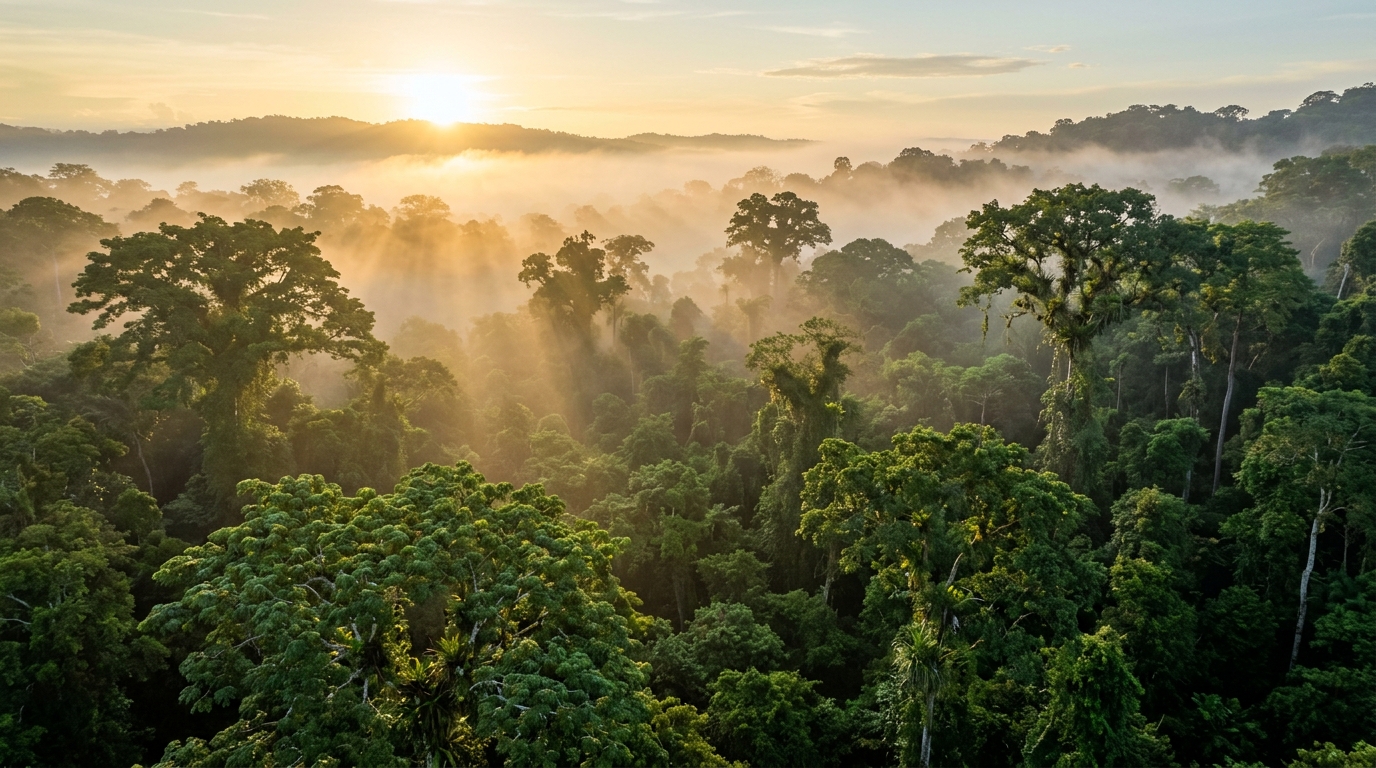
Tropical rainforests represent Earth’s oldest living ecosystems, having survived in continuous form for tens of millions of years. Covering less than 6% of the planet’s terrestrial landmass, these biological powerhouses harbor more than 50% of all terrestrial plant and animal species and regulate global precipitation patterns through massive evapotranspiration cycles.
Tropical rainforests are dense, moist terrestrial biomes located predominantly within the equatorial zone between 10 degrees North and 10 degrees South of the equator. Characterized by continuous warmth, excessive annual rainfall, and a year-round growing season, they represent the pinnacle of biological productivity and evolutionary complexity. The intricate relationships between vegetation layers, microclimates, nutrient cycling mechanisms, and biotic interactions make tropical rainforests indispensable regulators of our planet’s ecological equilibrium.
Throughout this comprehensive guide, we examine the structural anatomy of tropical rainforests, explore their unprecedented biological richness, investigate their vital role in global hydrological cycles, and evaluate the urgent conservation imperatives needed to safeguard these ancient sanctuaries.
1. Geographic Distribution and Climatic Characteristics
Tropical rainforests occur primarily in three major global regions: the Neotropical realm (spanning the Amazon basin, Central America, and the Caribbean), the Afrotropical realm (concentrated in the Congo Basin and coastal West Africa), and the Indomalayan-Australasian realm (stretching across Southeast Asia, Indonesia, the Philippines, and northeastern Australia). Minor pockets also persist along coastal mountain ranges where maritime winds create permanent moisture deposition.
Climatically, these forests are defined by the Köppen climate classification as Af (tropical rainforest climate). Key meteorological factors include:
- Continuous Warmth: Monthly mean temperatures consistently exceed 18°C (64°F), generally averaging between 24°C and 30°C throughout the year, with diurnal temperature fluctuations frequently surpassing annual seasonal variations.
- Abundant Precipitation: Annual rainfall ranges from a minimum of 2,000 mm (79 inches) to well over 10,000 mm (394 inches) in hyper-humid regions such as Chocó in Colombia and parts of Borneo.
- Sustained Relative Humidity: Daytime relative humidity rarely drops below 70%, frequently reaching 95% to 100% during nighttime cooling and immediate post-precipitation intervals.
- High Insolation: Intense solar radiation strikes the equatorial zone directly, providing the foundational energetic input that fuels relentless photosynthetic activity.
Table: Major Global Rainforest Basins Comparison
2. Vertical Stratification: The Four Ecological Forest Tiers
One of the most defining evolutionary adaptations of tropical rainforests is their complex four-tiered vertical architecture. Because sunlight is the principal limiting resource within dense equatorial forests, vegetation has evolved distinct structural strata, each housing unique biological communities adapted to varying levels of solar irradiance, wind velocity, humidity, and food availability.
Tier 1: The Emergent Layer (40 to 70+ meters)
The emergent layer consists of colossal, widely spaced giant trees that punch straight through the continuous canopy beneath them. Trees such as the Brazil nut (Bertholletia excelsa) and the kapok (Ceiba pentandra) dominate this windy, sun-drenched frontier. Living in this zone requires specialized adaptations: thick waxy cuticles on leaves to minimize desiccation from intense ultraviolet exposure and strong winds, and immense buttress roots spanning up to ten meters horizontally to anchor the massive trunks in shallow tropical soils. Birds of prey like the harpy eagle, crowned hawk-eagle, and bats utilize this layer for unobstructed vantage points.
Tier 2: The Continuous Canopy (25 to 45 meters)
Forming an unbroken biological roof over the forest, the canopy intercepts approximately 75% to 90% of incoming sunlight. This layer functions as the primary solar engine of the rainforest, containing roughly 70% to 80% of all rainforest animal and plant life. Epiphytic orchids, bromeliads, lichens, and lianas anchor themselves directly to tree branches, capturing moisture and atmospheric nutrients without taking sap from host trees. Tree frogs, toucans, spider monkeys, sloths, and countless specialized insect species spend their entire lifecycles within this vibrant canopy maze without ever descending to the ground.
Tier 3: The Shaded Understory (5 to 20 meters)
Beneath the dense canopy lies the dark, humid understory layer, which receives only 2% to 15% of ambient sunlight. Plants residing here, including dwarf palms, philodendrons, heliconias, and juvenile canopy trees, have developed broad, dark-green leaves rich in chlorophyll to maximize photon capture under extremely low-light regimes. Many understory plants produce striking, brightly colored, or pungent floral displays to attract specialized pollinators through the dim vegetation. Tree trunks are often adorned with cauliflorous fruits (such as wild cacao) that sprout directly from mature bark.
Tier 4: The Forest Floor (Ground Level)
The forest floor is characterized by near-total darkness, where less than 2% of sunlight penetrates. Despite the gloom, the forest floor is an energetic hub of decomposition. High ambient heat and humidity create ideal conditions for fungi, detritivorous insects, bacteria, and termites to decompose fallen logs, foliage, and animal waste with astonishing speed. An organic leaf that takes a year to decompose in a temperate woodland can vanish entirely within six weeks in a tropical rainforest floor.
3. Nutrient Dynamics and Soil Paradox: The Rapid Recycling Phenomenon
A classic ecological paradox of tropical rainforests is that their immense vegetative biomass flourishes on soils that are chemically impoverished and highly weathered. Unlike temperate soils that maintain deep, nutrient-dense humic horizons, tropical soils (predominantly oxisols and ultisols) are acidic, leached of soluble minerals, and rich in insoluble iron and aluminum oxides.
How does such boundless biological abundance survive on impoverished substrates? The answer lies in the closed, hyper-efficient nutrient cycling loop:
- Surface Root Mats: Tropical trees do not produce deep taproots; instead, nearly 90% of their root mass forms a dense, interwoven mesh in the top 10 to 30 cm of soil.
- Mycorrhizal Symbiosis: Fungal hyphae physically penetrate or wrap around tree root tips, forming extensive mutualistic networks. These mycorrhizae instantly absorb inorganic ions (phosphorus, nitrogen, potassium) released during rapid decomposition and transfer them directly into the plant vascular system before rainwaters can wash them away.
- Epiphytic Catchment: Epiphytes on high branches catch airborne dust, falling foliage, and rainwater, creating suspended canopy soils that harbor independent nutrient cycles tens of meters above the ground.
4. Global Climate Regulation and Flying Rivers
Tropical rainforests are not merely local ecosystems; they are planetary thermoregulatory and hydrological engines. Through the mechanism of evapotranspiration, a single mature rainforest tree can pump several hundred liters of water vapor into the atmosphere every single day. Across the vast Amazon basin, billions of trees collectively inject upwards of 20 billion metric tons of moisture into the atmosphere every 24 hours.
This immense volume of vapor forms vast atmospheric moisture corridors colloquially termed “flying rivers” (rios voadores). These aerial currents travel thousands of kilometers across continental landmasses, delivering rainfall to agricultural heartlands in southern South America, influencing hurricane pathways in the Atlantic, and stabilizing the global jet stream. Deforestation interrupts this thermodynamic cycle, triggering regional droughts, lengthening dry seasons, and creating self-reinforcing tipping points toward savanna degradation.
5. Critical Ecological Threats and Preservation Pathways
Despite their peerless ecological value, tropical rainforests face unprecedented existential pressures from human industrial expansion. Primary drivers of destruction include:
- Industrial Agriculture: Extensive clearing for commercial cattle ranching, soybean cultivation, and industrial oil palm plantations represents the leading driver of primary forest loss globally.
- Selective Logging and Road Building: The construction of access roads for selective timber extraction fragments contiguous forest blocks, desiccates microclimates, and exposes previously inaccessible forest interiors to illegal hunting and settlers.
- Mineral Extraction and Hydroelectric Projects: Large-scale gold mining, bauxite extraction, and megadam construction alter river flow regimes, pollute aquatic food webs with mercury, and drown thousands of square kilometers of pristine forest basins.
Effective preservation requires a multi-faceted approach combining legal recognition of Indigenous land tenures, implementation of strict deforestation-free supply chain mandates, ecological corridor expansion, and the scaling of high-integrity carbon offset mechanisms that economically reward forest-standing nations.
6. Frequently Asked Questions (FAQs)
Q1: Why are tropical rainforest soils generally nutrient-poor?
Rainforest soils are millions of years old and have been subjected to continuous, torrential rains that leach out vital soluble nutrients such as calcium, magnesium, and potassium. In these biomes, virtually all essential nutrients are locked within living biological tissue (trees, epiphytes, and animals) rather than stored in the soil itself. Rapid microbial decomposition immediately recycles nutrients back into living roots via mycorrhizal fungi.
Q2: How do tropical rainforests produce rainfall thousands of miles away?
Through evapotranspiration, massive expanses of rainforest release billions of tons of water vapor daily. Condensing clouds release latent heat, creating low-pressure zones that draw in moist oceanic air (the biotic pump mechanism). This circulating moisture travels along prevailing atmospheric currents as ‘flying rivers’, delivering vital precipitation across entire continents and moderating weather systems worldwide.
Q3: What happens to rainforest biodiversity when a forest is selectively logged?
Selective logging may leave some trees standing, but it disrupts the closed canopy, allowing intense sunlight and dry winds to penetrate the forest interior. This drastically alters microclimates, reducing relative humidity and causing sensitive understory species, amphibians, and shade-loving plants to perish. Furthermore, logging roads fragment animal territories, isolate gene pools, and increase vulnerability to catastrophic forest fires.
Tropical rainforests are Earth’s most biodiverse and structurally complex terrestrial biomes. Their vertical stratification creates four distinct ecological worlds, while their rapid nutrient cycles sustain lush life on weathered soils. Protecting these forests is not merely a regional priority—it is an absolute prerequisite for preserving global climate stability, safeguarding freshwater resources, and sustaining planetary biodiversity.
7. Deep Taxonomic Profiles: Flagship Rainforest Organisms
To fully appreciate the hyper-specialization of tropical rainforests, one must examine the extraordinary co-evolutionary relationships of flagship flora and fauna:
- The Brazil Nut Tree (Bertholletia excelsa): Reaching heights exceeding 50 meters, this giant cannot be cultivated in commercial plantations. It depends strictly on large female orchid bees (Euglossa) for pollination—the only insects strong enough to lift the heavy floral hood. Furthermore, its rock-hard woody seed capsules can only be cracked open by the agouti (Dasyprocta), a forest rodent with chisel-like teeth that caches surplus nuts in the soil, enabling germination.
- The Harpy Eagle (Harpia harpyja): Possessing rear talons larger than grizzly bear claws and exerting over 500 pounds per square inch of crushing pressure, the harpy eagle is the supreme apex avian predator of the Neotropical canopy. It hunts arboreal mammals, primarily two-toed sloths (Choloepus) and howler monkeys (Alouatta), maintaining population equilibrium among canopy herbivores.
- Leafcutter Ants (Genus Atta): Operating as the dominant agriculturalists of the forest understory, leafcutter ant colonies harvest hundreds of kilograms of fresh green foliage daily. They do not eat the leaves directly; they masticate them into an underground compost bed to cultivate an exclusive symbiotic fungus (Leucocoprinus gongylophorus), which feeds the queen and larvae.
8. Indigenous Ethnobotany and Pharmacological Discoveries
For millennia, Indigenous peoples have served as the living stewards of tropical rainforests, accumulating profound ethnobotanical wisdom. More than 120 prescription pharmaceuticals in modern global medicine originate from rainforest flora:
- Curare Alkaloids: Indigenous hunting darts tipped with extracts of Chondrodendron tomentosum led to the isolation of tubocurarine, which revolutionized modern abdominal surgery by safely relaxing skeletal muscles during anesthesia.
- Quinine: Derived from the bark of the Andean cinchona tree (Cinchona calisaya), quinine served as humanity’s premier antimalarial medication for over three centuries, enabling treatment of Plasmodium infections globally.
- Dragon’s Blood (Sangre de Drago): The red latex of Croton lechleri contains proanthocyanidins and the alkaloid taspine, proven in clinical trials to accelerate wound healing and treat viral enteritis.
9. Global Comparative Case Studies and Field Methodologies
Scientific exploration of The Comprehensive Guide to Tropical Rainforests: Structure, Biodiversity, and Planetary Climate Dynamics requires examining long-term empirical field data across diverse continents. Over the past five decades, ecological research stations—such as the Smithsonian Tropical Research Institute, the Long Term Ecological Research (LTER) network, and the European FluxNet system—have gathered millions of quantitative data points that demonstrate how microclimates, species interactions, and human pressures reshape habitat integrity over time.
Standardized field methodologies involve combining permanent forest dynamic plots (typically 50-hectare research quadrats where every tree exceeding 1 cm in diameter is tagged, mapped, and monitored) with eddy covariance flux towers. These towers rise high above forest canopies, measuring the continuous net ecosystem exchange (NEE) of carbon dioxide, water vapor, and heat fluxes between vegetation and the atmosphere at 20-millisecond frequencies, providing absolute empirical confirmation of planetary climate buffering.
Quantitative Field Metrics and Monitoring Parameters
10. Multilateral Policy Frameworks and 2030 Sustainable Development Goals
Preserving the integrity of The Comprehensive Guide to Tropical Rainforests: Structure, Biodiversity, and Planetary Climate Dynamics is intrinsically linked to achieving the United Nations 2030 Sustainable Development Goals (SDGs), particularly SDG 13 (Climate Action), SDG 14 (Life Below Water), and SDG 15 (Life on Land). International conventions, including the Convention on Biological Diversity (CBD) and the United Nations Framework Convention on Climate Change (UNFCCC), now mandate that national ecological action plans formally account for ecosystem services within gross domestic accounting systems.
Furthermore, the emergence of the Taskforce on Nature-related Financial Disclosures (TNFD) is revolutionizing corporate environmental responsibility. Multinational financial institutions and corporations are now legally required to assess, disclose, and actively mitigate their physical supply chain dependencies on wild ecosystems. By aligning private capital allocation with ecological regeneration, humanity is establishing the financial foundations necessary to ensure long-term evolutionary equilibrium across all global biomes.
Addressing the challenges outlined in ‘The Comprehensive Guide to Tropical Rainforests: Structure, Biodiversity, and Planetary Climate Dynamics’ demands a unified three-tiered approach: (1) Immediate legal moratoriums on industrial land conversion in primary frontier wildernesses; (2) Sovereign debt restructuring through debt-for-nature swaps that empower local conservation trusts; and (3) Scaling high-integrity biodiversity credits that directly fund local Indigenous communities and frontline conservation stewards.