FOREST ENERGY OBSERVATORY · ECOLOGY EXPLAINED
Every Forest Runs on a Network of Energy and Life.
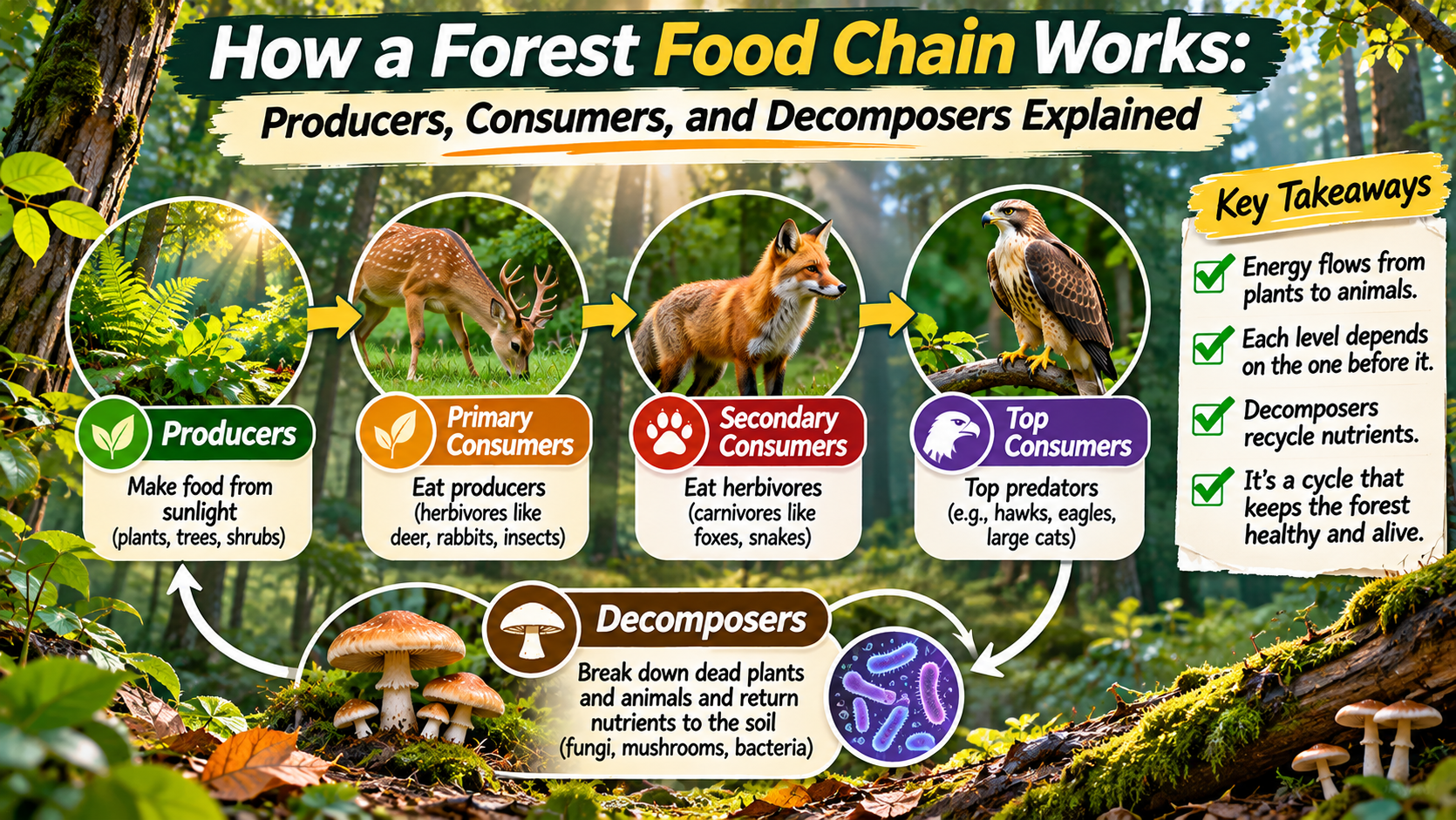
Follow the journey of energy from sunlight and green plants to herbivores, predators, fungi, and the organisms that recycle nutrients into the forest ecosystem.
🌿
PRODUCERS
CAPTURE ENERGY
🦊
CONSUMERS
TRANSFER ENERGY
🍄
DECOMPOSERS
RECYCLE NUTRIENTS
A forest may appear to be a peaceful collection of trees, plants, birds, and animals. Beneath that appearance, however, countless organisms are connected through feeding relationships.
Leaves capture sunlight. Caterpillars eat leaves. Birds eat caterpillars. Hawks may prey on smaller birds.
Meanwhile, fungi and bacteria break down dead leaves, fallen branches, and other organic material.
These relationships help explain how energy moves through an ecosystem and how nutrients remain available to support new life.
Ecologists use the term food chain to describe a simplified sequence in which one organism is eaten by another.
In a forest, food chains usually begin with producers, continue through different levels of consumers, and connect to decomposers that process dead organic material.
Real forests are more complicated than any single chain because organisms often have multiple food sources and predators.
Understanding the basic food chain is nevertheless an excellent starting point for exploring forest ecology.
What Is a Forest Food Chain?
A forest food chain is a sequence of feeding relationships that shows how energy passes from one organism to another.
Most forest food chains begin with plants that capture energy from sunlight through photosynthesis.
Herbivores obtain energy by eating plants or plant material.
Predators obtain energy by eating other animals.
Decomposers obtain energy from dead organic matter and help return nutrients to the ecosystem.
Food chains help scientists and students understand the roles of different organisms within an ecosystem.
However, they represent only one pathway through a much larger food web.
CORE ECOLOGY CONCEPT
Food-chain arrows show the direction of energy transfer.
When a caterpillar eats a leaf, energy moves from the plant to the caterpillar. When a bird eats the caterpillar, some of that energy moves to the bird.
1. Producers: The Foundation of Forest Food Chains
TROPHIC LEVEL 01 · PRODUCERS
The Energy Capturers
Producers are organisms that create organic food molecules using energy from sunlight or, in some ecosystems, chemical reactions. In forests, green plants are the dominant producers.
Most forest food chains begin with plants.
Trees, shrubs, grasses, mosses, and many other green plants capture sunlight and use it to produce sugars through photosynthesis.
These sugars provide energy and carbon-containing materials for plant growth.
Plants are called primary producers because they form the base of many terrestrial food chains.
Examples of Forest Producers
- Oak, maple, pine, and other trees.
- Woodland shrubs and berry-producing plants.
- Grasses and forest wildflowers.
- Mosses and other photosynthetic ground vegetation.
- Ferns and young tree seedlings.
Different forest types contain different producer communities.
Tropical forests may support numerous broadleaf tree species.
Temperate forests often contain deciduous and evergreen plants.
Boreal forests are frequently dominated by conifers, alongside shrubs, mosses, and other vegetation.
Why Producers Are Essential
Producers convert solar energy into chemical energy stored in organic molecules.
This energy supports plant growth and becomes available to consumers when they eat plant material.
Without producers, the familiar grazing food chains of forests could not function.
2. Primary Consumers: Animals That Eat Producers
TROPHIC LEVEL 02 · PRIMARY CONSUMERS
The Plant Eaters
Primary consumers obtain energy by eating producers or their products, including leaves, seeds, fruits, nectar, and other plant material.
Primary consumers are often herbivores.
They form the next major trophic level after producers.
In forests, primary consumers range from tiny insects to large mammals.
Examples of Primary Consumers
- Caterpillars feeding on tree leaves.
- Deer browsing on shoots and foliage.
- Rabbits eating grasses and other vegetation.
- Some squirrels consuming seeds and nuts.
- Plant-feeding beetles and other insects.
Some animals eat both plants and animals, so their trophic position can change depending on their diet.
For example, a bird may act as a primary consumer when eating seeds and as a secondary consumer when eating insects.
Why Primary Consumers Matter
Primary consumers transfer energy stored in plants to higher trophic levels.
They also influence vegetation through grazing, browsing, and seed consumption.
Some plant-eating animals help disperse seeds, connecting feeding behavior with forest regeneration.
3. Secondary Consumers: Animals That Eat Primary Consumers
TROPHIC LEVEL 03 · SECONDARY CONSUMERS
The Hunters of Herbivores
Secondary consumers obtain energy by eating primary consumers. They include many insect-eating birds, amphibians, reptiles, and predatory invertebrates.
Secondary consumers feed on organisms that obtain energy from producers.
For example, a bird that eats a leaf-feeding caterpillar functions as a secondary consumer in that feeding relationship.
Some frogs, spiders, and predatory insects also occupy this level when feeding on herbivorous organisms.
These animals help regulate populations of their prey.
However, their actual diets may include organisms from several trophic levels.
4. Tertiary Consumers: Predators Higher in the Food Chain
TROPHIC LEVEL 04 · TERTIARY CONSUMERS
Predators of Other Consumers
Tertiary consumers feed on secondary consumers. Their position depends on the particular feeding pathway being examined.
In a simplified forest food chain, a hawk that eats an insect-eating bird may function as a tertiary consumer.
Other predators can occupy higher trophic positions depending on what they eat.
However, large predators are not always tertiary consumers.
A predator that eats an herbivore is acting as a secondary consumer in that particular food chain.
This distinction is important because trophic levels describe feeding relationships, not simply an animal’s size or reputation.
5. Decomposers: Organisms That Break Down Dead Organic Matter
DECOMPOSITION PATHWAY · NUTRIENT CYCLING
The Forest’s Recycling Community
Decomposers break down dead organic material and waste, obtaining energy while helping transform nutrients into forms that can circulate through the ecosystem.
Every forest produces dead organic matter.
Leaves fall, branches break, animals die, and organisms release waste.
Fungi and bacteria play central roles in breaking down this material.
Many forest fungi can decompose complex compounds found in wood and leaf litter.
Bacteria also contribute to the transformation of organic matter.
Other organisms, including earthworms, woodlice, millipedes, and various insects, may act as detritivores or fragmenters.
These animals consume or physically break down dead material, making it more accessible to microorganisms.
Decomposers Are Not Simply the Final Step
Decomposition is often shown at the end of a basic food chain, but real ecosystems are more interconnected.
Dead material can originate from producers and consumers at every trophic level.
Decomposers process organic matter from throughout the food web.
They also support their own feeding relationships, because other organisms consume fungi, bacteria, and detritivores.
Therefore, decomposers are part of an interconnected ecosystem rather than a single final link.
A Simple Forest Food Chain Example
Consider a simplified feeding sequence in a temperate woodland.
EXAMPLE · WOODLAND ENERGY PATHWAY
Producer
↓
Primary Consumer
↓
Secondary Consumer
↓
Tertiary Consumer
The arrows indicate the direction of energy transfer from food to the organism that consumes it.
This example is illustrative rather than a claim that every oak woodland contains this exact feeding sequence.
Real species interactions vary by location and season.
Dead leaves, waste, and remains from organisms throughout this chain can also enter decomposition pathways.
How Energy Moves Through a Forest Food Chain
Energy enters most forest food chains when plants capture sunlight.
Plants convert some of that energy into chemical energy through photosynthesis.
Consumers obtain a portion of this energy when they eat plants or other organisms.
However, not all energy consumed becomes new biomass.
Organisms use energy for respiration, movement, growth, reproduction, and other activities.
Some energy is released as heat, and some remains in material that is not consumed or digested.
As a result, less energy is generally available to support organisms at higher trophic levels.
The 10% Rule
Ecology textbooks sometimes use the 10% rule to illustrate energy transfer between trophic levels.
Under this simplified model, approximately 10% of the energy available at one trophic level becomes available as production at the next.
For example, if producers contain 10,000 units of energy, the model might show 1,000 units at the primary-consumer level, 100 at the secondary-consumer level, and 10 at the tertiary-consumer level.
These figures are illustrative, not fixed measurements.
Actual transfer efficiency varies substantially among ecosystems, organisms, and feeding relationships.
ILLUSTRATIVE ENERGY PYRAMID
10 units
100 units
1,000 units
10,000 units
This simplified pyramid demonstrates decreasing energy availability at higher trophic levels. Actual ecological efficiencies vary.
Food Chains vs. Food Webs: What’s the Difference?
A food chain shows one feeding pathway.
A food web shows multiple interconnected feeding relationships within an ecosystem.
For example, a forest caterpillar may be eaten by several bird species, spiders, or other predators.
A bird may consume insects, fruits, and seeds.
A hawk may hunt different types of prey.
These overlapping relationships create a food web.
Food webs provide a more realistic picture of ecosystem complexity because most organisms interact with multiple species.
They also help explain why changes in one population may affect several other populations.
Why Nutrients Cycle but Energy Does Not
Energy and nutrients move through ecosystems in different ways.
Energy enters most forest ecosystems through sunlight and moves through organisms as they feed.
During biological processes, some energy is eventually dissipated as heat.
It is not recycled back into usable sunlight.
Nutrients, however, can move repeatedly between organisms, soils, water, and the atmosphere.
For example, a tree absorbs nutrients from soil.
An herbivore eats part of the tree.
Waste and dead organic matter are processed by decomposers.
Some nutrients eventually become available for uptake by plants again.
This distinction is fundamental to ecosystem ecology.
IMPORTANT DISTINCTION
Energy flows through ecosystems. Nutrients cycle through ecosystems.
Decomposers are essential to nutrient cycling, but they do not recycle energy that has already been dissipated as heat.
Examples of Forest Food Chains
Different forest environments contain different feeding relationships.
Temperate Forest Example
Tree leaves → Caterpillar → Insect-eating bird → Hawk
This example illustrates how energy can move from a producer through three consumer levels.
Boreal Forest Example
Willow shoots → Snowshoe hare → Lynx
This simplified chain represents a plant, an herbivore, and a predator in a northern forest ecosystem.
Tropical Forest Example
Forest leaves → Leaf-eating insect → Insect-eating frog → Snake
This illustrative sequence shows how energy can pass through several organisms in a tropical forest.
Actual feeding relationships depend on the species present and local ecological conditions.
What Happens When One Part of a Food Chain Changes?
Food chains are connected to population dynamics and ecosystem balance.
If a major food source becomes less available, organisms that depend on it may be affected.
If a predator population declines, some prey populations may increase under certain conditions.
However, ecosystem responses are rarely simple.
Other predators, competing species, disease, weather, and food availability can influence the outcome.
Changes that spread through several trophic levels are sometimes described as trophic cascades.
These effects depend on the ecological relationships involved and do not occur in the same way in every forest.
Why Decomposers Are Essential to Forest Health
Decomposers connect living organisms with the dead organic matter produced throughout the ecosystem.
Without decomposition, large amounts of organic material would accumulate without being transformed at normal rates.
Fungi and bacteria help break down leaves, wood, and other materials.
These processes contribute to nutrient availability, soil development, and the functioning of forest food webs.
Decomposition rates vary with temperature, moisture, wood chemistry, and the organisms involved.
In warm, moist forests, decomposition may proceed relatively quickly.
In colder environments, some organic materials may persist for much longer.
Both patterns influence forest soils and carbon storage.
How Human Activities Can Affect Forest Food Chains
Deforestation, habitat fragmentation, pollution, invasive species, and climate change can influence forest food webs.
Removing vegetation may reduce food and shelter for herbivores.
Changes in herbivore populations can affect predators.
Disturbances to soil communities may influence decomposition and nutrient cycling.
Climate-related changes can also alter the timing of plant growth and animal activity.
For example, if insect emergence shifts relative to the breeding season of insect-eating birds, food availability may change.
These effects vary by species and region.
Protecting forest habitats and ecological connectivity can help maintain the relationships that support functioning ecosystems.
How to Observe a Forest Food Chain During a Nature Walk
You do not need to witness a predator catching prey to observe evidence of forest food chains.
Look for leaves with insect feeding marks.
Watch birds searching branches for insects.
Notice seeds, fruits, and nuts that provide food for wildlife.
Observe fungi growing on fallen wood and leaf litter.
These observations reveal different parts of the forest’s feeding relationships.
Forest Food Chain Field Notes — Example
Producer: Oak tree with green leaves
Primary consumer evidence: Caterpillar feeding damage on leaves
Secondary consumer observation: Small bird searching foliage for insects
Decomposer observation: Fungi growing on a fallen branch
Question: Which feeding relationships were directly observed, and which remain hypotheses?
This fictional example demonstrates how to record ecological observations without assuming that every nearby organism is directly connected in a single food chain.
Forest Food Chain: Quick Comparison of Ecological Roles
| Role | Energy Source | Forest Examples |
|---|---|---|
| Producers | Primarily sunlight | Trees, shrubs, grasses, mosses |
| Primary Consumers | Producers | Caterpillars, deer, plant-eating insects |
| Secondary Consumers | Primary consumers | Insect-eating birds, some frogs, predatory insects |
| Tertiary Consumers | Secondary consumers | Hawks and other predators in suitable feeding chains |
| Decomposers | Dead organic matter | Fungi and bacteria |
Frequently Asked Questions
What is a forest food chain?
A forest food chain is a simplified sequence showing how energy passes from one organism to another through feeding relationships.
What are the three main groups in a forest food chain?
The three broad groups commonly discussed are producers, consumers, and decomposers. Consumers can be divided into different trophic levels.
What are examples of producers in forests?
Trees, shrubs, grasses, ferns, mosses, and other photosynthetic plants are examples of forest producers.
What are primary consumers?
Primary consumers are organisms that eat producers or their products, such as leaves, seeds, and fruits.
What do decomposers do in a forest?
Decomposers break down dead organic matter and waste, helping transform and recycle nutrients within the ecosystem.
What is the difference between a food chain and a food web?
A food chain shows one feeding pathway, while a food web shows multiple interconnected feeding relationships.
Why is less energy available at higher trophic levels?
Organisms use energy for biological activities, and some energy is dissipated as heat or remains in material that is not transferred to the next consumer.
Can an animal occupy more than one trophic level?
Yes. Omnivores and other animals with varied diets may occupy different trophic levels depending on what they eat.
Final Thoughts
Forest food chains reveal the feeding relationships that connect plants, animals, fungi, and microorganisms.
Producers capture energy from sunlight and create organic matter.
Primary consumers obtain energy from producers.
Secondary and tertiary consumers transfer energy through additional feeding relationships.
Decomposers process dead organic matter and contribute to nutrient cycling.
Although a food chain provides a useful introduction, real forests contain interconnected food webs with many overlapping relationships.
Understanding these connections helps explain why changes affecting one group of organisms can influence other parts of the ecosystem.
It also highlights the importance of conserving forest habitats, maintaining biodiversity, and protecting the ecological processes that sustain life.
THE FOREST ENERGY TAKEAWAY
Producers Capture Energy. Consumers Transfer It. Decomposers Recycle Nutrients.
Every forest depends on connected feeding relationships that move energy through living organisms and keep nutrients circulating through the ecosystem.