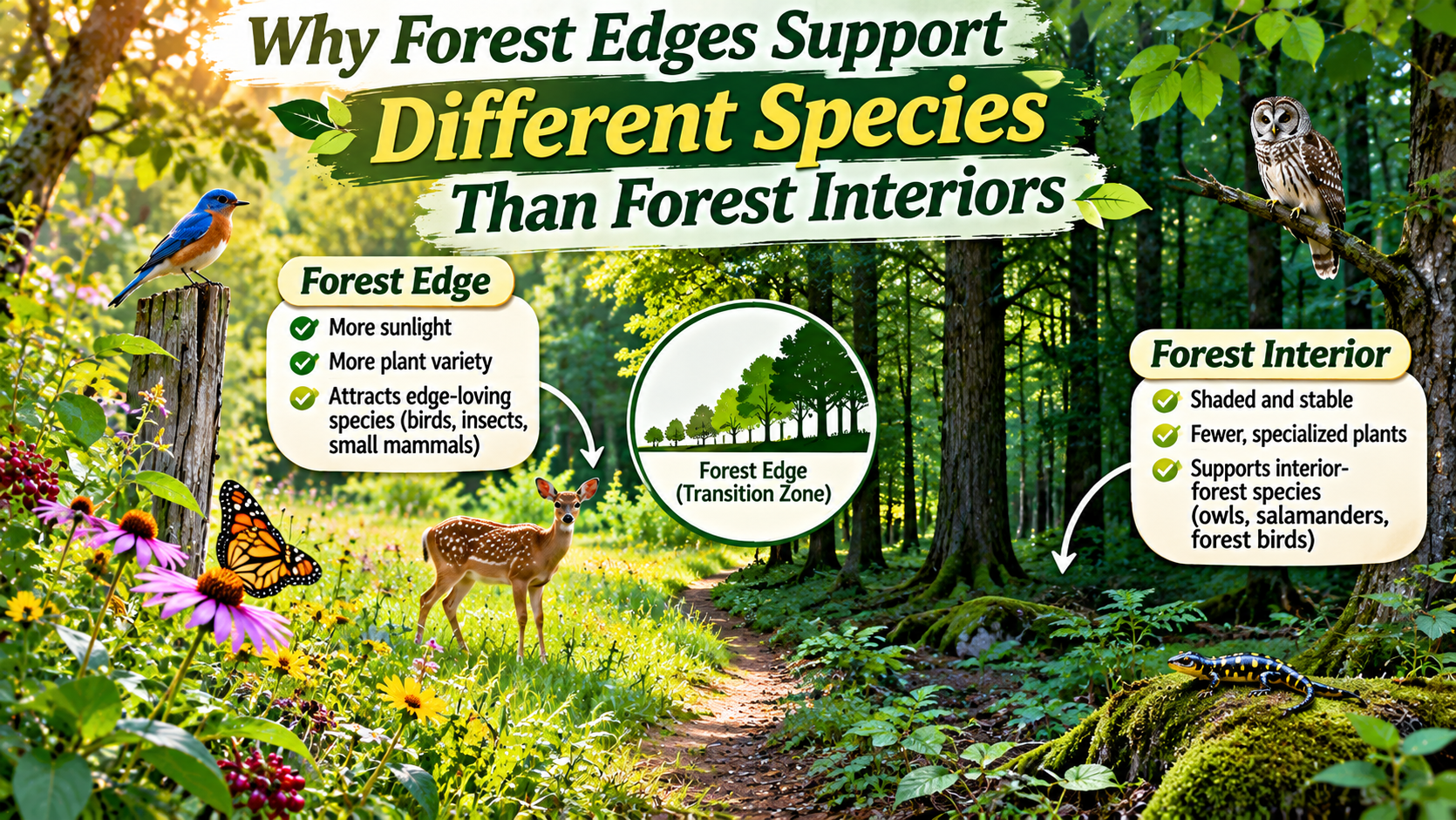
FOREST ECOLOGY LAB · HABITAT STUDY 06
Where the Forest Meets the Open World.
Explore why sunlight, wind, temperature, vegetation, and wildlife interactions change between forest boundaries and the shaded woodland interior.
☀️🌾
FOREST EDGE
MORE LIGHT · GREATER EXPOSURE
🌲🌿
FOREST INTERIOR
MORE SHADE · BUFFERED CONDITIONS
Walk along the boundary of a forest and you may notice birds singing from shrubs, butterflies visiting flowers, and grasses growing beneath scattered trees.
Move farther into the woodland, and the environment often changes.
The air may feel cooler, the light becomes softer, and the vegetation beneath the canopy may look very different.
These changes are not simply visual.
Forest edges and forest interiors can provide different environmental conditions, resources, and ecological relationships.
As a result, they often support different combinations of plants, animals, fungi, and other organisms.
Ecologists describe many of these differences through the concept of edge effects.
Understanding edge effects helps explain patterns of biodiversity, wildlife movement, habitat fragmentation, and forest conservation.
This guide explores why forest boundaries differ from interior habitats, which species may benefit from each environment, and why maintaining healthy forest interiors remains important.
What Is a Forest Edge?
A forest edge is the boundary or transition area between forest vegetation and another type of habitat.
For example, a forest may border a grassland, agricultural field, road, wetland, or developed area.
Some forest edges occur naturally, such as where woodland meets a meadow or lake.
Others are created or altered by human activities, including logging, road construction, and land clearing.
Forest edges are not always sharp lines.
Some form gradual transitions with shrubs, young trees, and scattered vegetation.
Others have abrupt boundaries where dense woodland meets open land.
The ecological effects of an edge depend on its shape, orientation, surrounding habitat, and local climate.
What Is a Forest Interior?
A forest interior is an area located sufficiently far from a forest boundary that it experiences fewer direct influences from the surrounding open environment.
Interior habitats often have more buffered temperature, humidity, wind, and light conditions than exposed edges.
However, the distance required to create interior conditions varies.
In some forests, particular edge effects extend only a short distance.
Other effects may penetrate much farther, depending on the landscape and ecological process involved.
Therefore, there is no single universal distance that defines a forest interior.
ECOLOGY PRINCIPLE
The forest boundary changes the conditions for life.
Light, wind, temperature, moisture, vegetation structure, and species interactions can change as you move from a forest edge toward the interior.
1. Sunlight Creates Different Growing Conditions
One of the most noticeable differences between forest edges and interiors is the amount of sunlight reaching the ground.
At many forest edges, sunlight can enter from the side as well as from above.
This may allow grasses, flowering plants, vines, and shrubs to grow more vigorously.
These plants can provide food and shelter for insects, birds, and small mammals.
Deeper inside a closed-canopy forest, much of the sunlight is intercepted by leaves and branches.
Plants growing beneath the canopy must tolerate lower light levels.
Some understory species have adaptations that help them survive in shade.
Others take advantage of seasonal light availability, such as spring wildflowers that grow before deciduous trees develop their full leaf canopy.
The result is often a different plant community at the edge compared with the interior.
2. Temperature and Humidity Change Across the Boundary
Forest canopies influence local environmental conditions.
Shade reduces direct solar heating, while vegetation and soil moisture affect humidity and temperature.
As a result, forest interiors may experience more buffered microclimates than exposed edges.
At forest boundaries, greater exposure to sunlight and wind can create warmer and drier conditions during certain periods.
However, the direction and strength of these differences vary with season, time of day, weather, and forest type.
These microclimate changes matter because organisms differ in their tolerance for heat, dryness, and environmental fluctuations.
Some plants and animals thrive in open, variable conditions.
Others depend on the relatively stable environments found deeper within forests.
3. Wind Exposure Influences Trees and Vegetation
Forest edges are often more exposed to wind than protected interior areas.
Wind can influence tree movement, evaporation, branch damage, and the dispersal of seeds.
Strong winds may also increase the risk of damage to trees at newly created forest boundaries.
Interior trees may experience less direct wind exposure because surrounding vegetation provides shelter.
However, storms can still affect deep forest areas.
Wind exposure can influence which plants establish successfully near a boundary and how the forest develops over time.
4. Forest Edges Often Support More Shrubs and Flowering Plants
Increased light availability can encourage dense vegetation at some forest boundaries.
Shrubs, young trees, grasses, and flowering plants may become prominent.
These plants can provide nectar, seeds, berries, and cover for wildlife.
Pollinating insects may visit flowering plants along sunny edges.
Birds may use shrubs for nesting, shelter, or feeding.
Small mammals may benefit from dense ground vegetation.
However, not every forest edge has abundant plant growth.
Edges bordering roads, heavily managed fields, or other disturbed environments may have limited vegetation or unfavorable conditions.
5. Forest Interiors Support Shade-Adapted Species
Forest interiors can provide habitats for organisms that depend on shaded, humid, or relatively stable conditions.
Some woodland plants grow best beneath established tree canopies.
Certain mosses, fungi, amphibians, and invertebrates may benefit from moist microhabitats.
Some bird species prefer extensive forest habitats and may avoid heavily fragmented landscapes.
Interior habitats can also provide conditions associated with mature forests, including large trees, deadwood, and complex vegetation structures.
These features are not exclusive to forest interiors, but their availability may be influenced by forest size and disturbance history.
6. Bird Communities Often Differ Between Edges and Interiors
Birds provide useful examples of how species respond to habitat differences.
Some species frequently use forest edges because they provide access to shrubs, open feeding areas, and nearby woodland cover.
Other species are more closely associated with extensive forest interiors.
The exact patterns depend on geographic region, forest type, and landscape conditions.
Birds Commonly Associated With Edges
In some regions, edge habitats support species that forage in shrubs, open spaces, or mixed vegetation.
These may include certain sparrows, buntings, flycatchers, and other birds adapted to transitional habitats.
Many species use edges only during particular seasons or activities.
Birds Associated With Forest Interiors
Some woodland birds are more strongly associated with larger forest patches and interior habitat conditions.
Depending on the region, these may include particular forest warblers, thrushes, and other woodland specialists.
Such species may be sensitive to changes in habitat structure, fragmentation, or ecological interactions.
However, forest-interior preference does not mean that a bird never visits an edge.
Habitat use is often flexible and changes with season and life stage.
7. Forest Edges Can Increase Some Predator Interactions
Forest boundaries may influence interactions between predators and prey.
Some predators move along edges or use open areas to search for food.
In certain landscapes, nest predators may be more common or more active near forest boundaries.
However, these patterns are not universal.
Predation risk depends on the predator community, surrounding land use, forest structure, and regional conditions.
For some bird species, changes in predation or nest parasitism can influence breeding success.
Researchers therefore examine edge effects on wildlife reproduction rather than assuming that every edge is equally risky.
8. Forest Edges May Be More Vulnerable to Invasive Species
Disturbed forest boundaries can provide opportunities for some non-native plants and animals to establish.
Greater light availability, soil disturbance, and nearby human activity may contribute to these patterns.
Some invasive plants spread rapidly along roadsides and forest margins.
Once established, they may compete with native vegetation or alter habitat conditions.
However, invasive species are not limited to forest edges.
They can also affect interior habitats, especially when disturbances or dispersal pathways allow them to spread.
Forest Edge vs. Forest Interior: Key Differences
| Feature | Forest Edge | Forest Interior |
|---|---|---|
| Sunlight | Often greater exposure | Often more shaded |
| Wind | Often stronger exposure | Usually more sheltered |
| Temperature | May fluctuate more | Often more buffered |
| Humidity | May be lower during exposed conditions | Often more stable |
| Vegetation | Often shrubs, grasses, and young trees | Shade-tolerant understory plants |
| Wildlife | May favor edge-adapted species | May favor interior specialists |
| Disturbance | Often greater exposure to surrounding activities | Can be more protected from external influences |
These are general tendencies rather than fixed rules. The strength and direction of edge effects vary among ecosystems.
9. What Is the Edge Effect in Ecology?
The term edge effect describes changes in ecological conditions or processes near the boundary between different habitats.
These changes may involve temperature, light, vegetation, species abundance, predation, or other factors.
Some species become more common near edges.
Others become less common.
Some species show little response.
Therefore, an edge effect is not automatically beneficial or harmful.
Its ecological significance depends on which species or process is being studied.
UNDERSTANDING THE EDGE GRADIENT
☀️
OPEN HABITAT
🌾
FOREST EDGE
🌲
FOREST INTERIOR
This simplified gradient illustrates how habitat conditions may change from open land into a forest. Real transitions can be gradual, irregular, or abrupt.
10. How Forest Fragmentation Creates More Edges
Forest fragmentation occurs when a larger continuous forest is divided into smaller patches.
Roads, agriculture, development, and other land-use changes can contribute to fragmentation.
When a forest is divided into smaller patches, the total amount of edge habitat may increase relative to interior habitat.
For example, a compact forest patch may contain more interior habitat than a long, narrow patch with the same total area.
This happens because the narrow patch has a greater proportion of land close to a boundary.
Fragmentation can therefore change habitat availability even when some forest cover remains.
Species that depend on large, connected forest areas may be particularly affected.
11. Why Forest Patch Size and Shape Matter
The size and shape of a forest patch influence how much of it is exposed to edge conditions.
A large, compact patch may contain extensive interior habitat.
A narrow strip of woodland may experience edge influences across much of its width.
However, patch geometry is only part of the story.
The surrounding landscape also matters.
A forest bordered by another wooded habitat may experience different edge conditions from a forest bordering a large paved area.
Connectivity between forest patches can influence animal movement and dispersal.
These factors are important when planning conservation areas and habitat restoration.
12. Can Forest Edges Increase Biodiversity?
Some forest edges support a mixture of species associated with woodland and nearby open habitats.
This can increase the number of species observed within a small area.
However, higher local species richness does not necessarily mean that the habitat is healthier or more valuable for conservation.
Edge-adapted generalists may become more common while sensitive interior specialists decline.
Therefore, biodiversity assessments should consider species identity, habitat quality, and conservation status rather than species counts alone.
Both natural transitions and intact forest interiors can contribute important ecological value.
13. How to Observe Edge Effects During a Forest Walk
Forest boundaries provide useful opportunities to study habitat differences.
Choose a safe, established trail that passes from an open area into woodland.
Observe how light, wind, vegetation, and wildlife activity change along the route.
Listen for bird calls and notice where different species appear.
Look for changes in ground vegetation, leaf litter, and moisture.
Avoid leaving trails or disturbing sensitive habitats.
Forest Edge Field Notes — Example
Location: Woodland beside a meadow
Edge conditions: Bright sunlight, noticeable wind, flowering shrubs
Interior conditions: More shade, reduced wind, fewer flowering shrubs
Wildlife observations: Several insects near edge flowers; woodland birds heard deeper inside
Question for further study: Do the same patterns occur at different times of day?
This fictional example demonstrates how simple observations can generate questions about forest ecology.
14. Why Conservation Must Consider Both Edges and Interiors
Forest conservation is not simply about preserving a certain number of trees.
It also involves maintaining habitat quality, connectivity, and ecological processes.
Natural forest edges can support valuable transitional habitats.
At the same time, extensive forest interiors provide conditions needed by some specialized organisms.
Conservation strategies may include protecting large forest patches, maintaining habitat corridors, restoring degraded boundaries, and reducing unnecessary fragmentation.
The most appropriate approach depends on the forest type, surrounding landscape, and conservation goals.
Protecting both habitat diversity and interior conditions can help support a broader range of species.
Frequently Asked Questions
What is a forest edge?
A forest edge is the boundary or transition area between woodland and another habitat, such as grassland, farmland, a wetland, or developed land.
What is the edge effect?
The edge effect describes ecological changes near habitat boundaries, including differences in light, temperature, vegetation, species abundance, and biological interactions.
Why do forest edges have different species?
Forest edges often experience different environmental conditions and resource availability, which favor some species while making the habitat less suitable for others.
Are forest edges more biodiverse than interiors?
Some edges contain a mixture of species from neighboring habitats, but higher species counts do not necessarily indicate better habitat quality or conservation value.
Why are forest interiors important?
Forest interiors can provide buffered microclimates and extensive habitats for organisms that are sensitive to disturbance or fragmentation.
How does fragmentation affect forest species?
Fragmentation can increase edge exposure, reduce interior habitat, alter connectivity, and change ecological interactions.
Do all forests experience the same edge effects?
No. Edge effects vary with climate, forest structure, boundary type, surrounding land use, and the species or process being studied.
Can forest edges be beneficial?
Yes. Natural edges can provide valuable transitional habitats, although some human-created edges may negatively affect forest-interior species.
Final Thoughts
Forest edges and interiors are connected parts of woodland ecosystems, but they often provide different environmental conditions.
Edges may receive more sunlight, experience greater wind exposure, and support vegetation adapted to transitional habitats.
Interiors often provide more buffered conditions that benefit some shade-adapted plants and forest specialists.
These differences influence wildlife communities, species interactions, and patterns of biodiversity.
Understanding edge effects also helps explain why forest fragmentation can change ecosystems even when some trees remain standing.
Healthy landscapes may require both natural habitat transitions and sufficiently large areas of intact forest interior.
By observing these environments carefully, nature enthusiasts can better understand how habitat boundaries shape the distribution of life.
THE FOREST EDGE TAKEAWAY
Different Light. Different Conditions. Different Communities.
Forest edges and interiors support different ecological relationships, making habitat structure and connectivity essential considerations in forest conservation.