FOREST FLOOR DISCOVERY JOURNAL · ECOLOGY GUIDE
A Fallen Tree Is the Beginning of Another Story.
Discover how deadwood becomes a living habitat, feeds forest soil, stores carbon, and creates opportunities for the next generation of trees.
🍄
DECOMPOSITION
🪲
WILDLIFE HABITAT
🌱
NEW GROWTH
When a large tree falls in a forest, it may appear that an important part of the ecosystem has been lost.
Its branches lie scattered across the ground, its trunk begins to weather, and its leaves eventually disappear.
Yet the ecological role of the tree does not end when it dies.
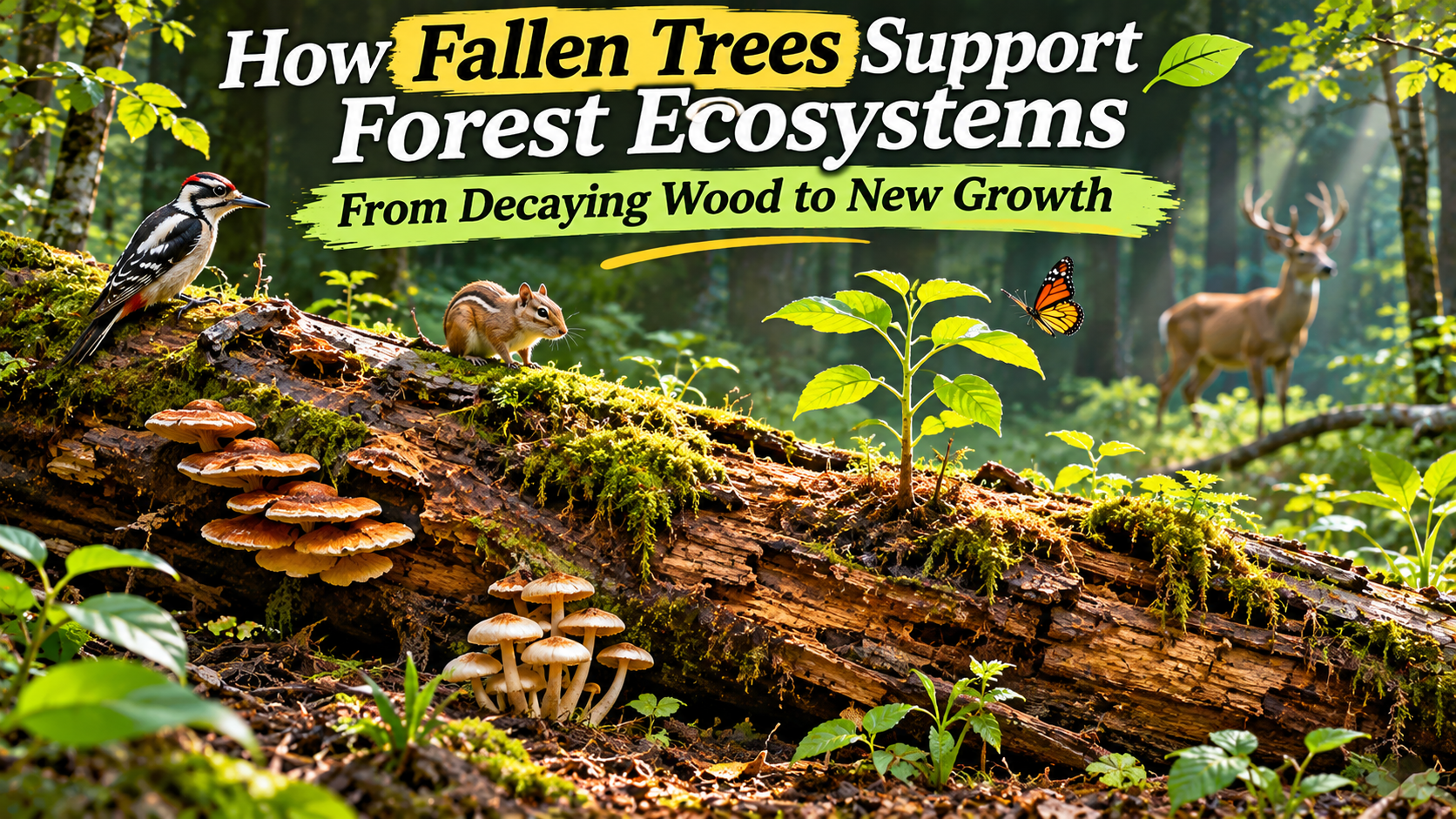
In many forests, fallen trees become essential habitats for insects, fungi, mosses, birds, amphibians, and other organisms.
As wood gradually decomposes, nutrients move through the ecosystem, moisture conditions change, and new opportunities for plant growth emerge.
Some fallen trunks even become natural seedbeds where young trees establish themselves.
Ecologists often refer to fallen logs, large branches, and other substantial deadwood on the forest floor as coarse woody debris.
Although the term sounds unremarkable, this material plays important roles in forest biodiversity, nutrient cycling, soil development, and regeneration.
This guide explores how fallen trees support forest ecosystems, from the first stages of decomposition to the growth of new vegetation.
Why Fallen Trees Matter in Healthy Forests
Forests are constantly changing.
Trees grow, compete for sunlight, respond to disturbances, and eventually die.
Some fall because of storms, strong winds, erosion, disease, or natural aging.
Others remain standing as dead trees before eventually collapsing.
These processes are part of the natural development of many forest ecosystems.
A fallen tree creates structural complexity on the forest floor.
It may provide shelter for animals, retain moisture, support decomposer organisms, and influence the movement of water and sediment.
Large logs can remain recognizable for many years, sometimes decades or longer, depending on the tree species and environmental conditions.
During that time, they may support different communities of organisms as decomposition progresses.
FOREST ECOLOGY PRINCIPLE
Deadwood is part of a living ecosystem.
Fallen trees provide physical habitat and organic material that support organisms and ecological processes long after the original tree has stopped growing.
1. Fallen Trees Create Habitats for Wildlife
One of the most immediate benefits of a fallen tree is the shelter it provides.
Logs, branches, loose bark, and spaces beneath decaying wood create small habitats with different temperature and moisture conditions.
These environments may be used by insects, spiders, amphibians, reptiles, small mammals, and other organisms.
Insects and Other Invertebrates
Many invertebrates depend on deadwood during part of their life cycle.
Some beetle larvae develop within decaying wood.
Other insects feed on fungi growing inside logs.
Woodlice, millipedes, and various small organisms may use damp spaces beneath fallen branches.
These invertebrates contribute to decomposition and form part of the forest food web.
Amphibians and Reptiles
Moist spaces around fallen logs can provide suitable shelter for some salamanders, frogs, and other amphibians.
Reptiles may also use logs for cover or basking, depending on the climate and species.
These habitats are especially valuable where exposed ground becomes hot or dry.
Small Mammals
Some small mammals use fallen wood for shelter, movement corridors, or protection from predators.
Logs may also create places where animals search for insects, seeds, and other food.
The importance of these habitats varies across forest types.
Birds
Fallen trees can support birds indirectly by providing food resources.
Woodpeckers and other insect-eating birds may search deadwood for insects and larvae.
Some birds use fallen branches as perches or forage among the vegetation that develops around logs.
Standing dead trees, known as snags, are particularly important nesting habitats for many cavity-nesting birds.
2. Fungi Begin Breaking Down the Wood
Fungi are among the most important organisms involved in wood decomposition.
Wood contains complex structural materials, including cellulose, hemicellulose, and lignin.
Many fungi produce enzymes that help break down these materials.
As fungi grow through deadwood, they gradually change its structure and chemical composition.
Some fungi produce visible mushrooms or shelf-like fruiting bodies.
However, much of the fungal organism remains hidden within the wood as networks of microscopic filaments.
Different fungal species specialize in different substrates and stages of decomposition.
These interactions help explain why a fallen tree may support changing fungal communities over time.
White Rot and Brown Rot
Two commonly discussed patterns of fungal wood decay are white rot and brown rot.
White-rot fungi can break down lignin as well as other wood components, often leaving wood with a pale, fibrous appearance.
Brown-rot fungi primarily break down cellulose and hemicellulose, often leaving darker, brittle material rich in modified lignin.
Both processes contribute to changes in deadwood structure and nutrient cycling.
The exact appearance depends on the fungi, tree species, and environmental conditions.
3. Decomposition Returns Nutrients to the Ecosystem
When a tree is alive, it stores nutrients in its wood, bark, leaves, roots, and other tissues.
After the tree dies, these materials gradually become available to decomposer organisms.
Fungi, bacteria, and invertebrates help transform dead organic matter.
Over time, some nutrients are released into surrounding soils and can be taken up by plants and microorganisms.
Other nutrients remain temporarily stored in decomposer biomass or organic matter.
The process is not always a simple one-way transfer from wood directly into soil.
Decomposers can also absorb nutrients from their surroundings while breaking down carbon-rich wood.
The rate and direction of nutrient movement depend on the wood’s chemistry, soil conditions, and decomposer community.
THE DEADWOOD NUTRIENT CYCLE
Tree Growth → Tree Death → Decomposition → Nutrient Cycling → New Growth
This simplified cycle shows how fallen trees contribute to the movement and reuse of nutrients within forest ecosystems. The actual process involves many organisms and overlapping pathways.
4. Fallen Logs Can Become Natural Seedbeds
One of the most fascinating roles of fallen trees is their ability to support new plant growth.
In some forests, seedlings establish themselves directly on decaying logs.
These logs are often called nurse logs.
As wood softens and accumulates organic material, it may provide a moist surface where seeds can germinate.
Depending on the forest, a nurse log may also reduce competition from some ground vegetation.
Mosses and other plants can grow across the decaying surface.
Over time, young trees may develop roots that extend through the log and into the surrounding soil.
As the original log decomposes further, the growing tree may remain supported by its own root system.
Why Nurse Logs Are Important
Nurse logs can provide several potential benefits for seedlings:
- Moist surfaces that may support seed germination.
- Elevated growing positions above some competing vegetation.
- Organic material that changes as decomposition progresses.
- Microsites with different temperature and moisture conditions.
- Opportunities for roots to develop through softened wood.
These benefits vary by tree species, forest climate, log condition, and surrounding vegetation.
Not every fallen tree becomes a successful nurse log.
5. Fallen Trees Help Maintain Moisture on the Forest Floor
Large pieces of deadwood can influence moisture conditions in forests.
Decaying wood may absorb and retain water, particularly after its structure becomes more porous.
Logs can also shade small areas of soil and reduce direct exposure to sunlight and wind.
These conditions may create relatively moist microsites.
Such areas can support mosses, fungi, seedlings, and moisture-sensitive animals.
The effect depends on local climate, wood condition, and position.
In dry environments, deadwood may not remain consistently moist.
Nevertheless, fallen logs can increase the variety of microhabitats available on the forest floor.
6. Deadwood Supports Complex Forest Food Webs
Fallen trees do not support only the organisms that directly consume wood.
They also support animals that feed on decomposers and other organisms living within deadwood.
For example, fungi break down wood and create resources for certain insects.
Those insects may become food for birds, amphibians, or small mammals.
Predators may then feed on some of these animals.
These relationships connect deadwood to wider forest food webs.
As a log decomposes, its structure changes.
Different organisms may become more or less common as new habitats and food resources develop.
This changing succession of communities helps make deadwood an important component of forest biodiversity.
7. Fallen Trees Influence Soil Development
Deadwood contributes organic matter to forest environments.
As wood decomposes, some of its material becomes incorporated into surrounding soils.
Organic matter can influence soil structure, moisture retention, and biological activity.
Fallen trees also create physical differences across the forest floor.
Large logs may trap leaves, small branches, and sediment.
These accumulations can create localized areas with different soil conditions.
Over long periods, such processes contribute to the complexity of forest soils.
However, soil development depends on many additional factors, including climate, parent material, topography, vegetation, and time.
8. Fallen Trees Play a Role in Forest Carbon Storage
Trees absorb carbon dioxide during photosynthesis and store carbon in their tissues.
When a tree dies, much of that carbon initially remains in the deadwood.
As decomposition proceeds, microorganisms release some carbon back into the atmosphere through respiration.
Some carbon may also enter soil organic matter or remain stored in partially decomposed material.
The balance depends on temperature, moisture, wood chemistry, and decomposer activity.
Cold or waterlogged conditions can slow decomposition, allowing deadwood and associated organic matter to persist longer.
In warmer and moist environments, decomposition may proceed more rapidly.
Deadwood is therefore an important component of forest carbon accounting, although it is not a permanent carbon store.
9. How Decomposition Changes Over Time
A newly fallen tree does not provide the same habitat as a log that has been decaying for decades.
As wood breaks down, its texture, moisture content, structure, and biological communities change.
| Stage | Typical Characteristics | Ecological Role |
|---|---|---|
| Recently fallen | Wood remains relatively firm; bark may be intact | Provides structure and habitat for early colonizers |
| Early decay | Fungal activity increases; bark may loosen | Supports decomposers and associated wildlife |
| Advanced decay | Wood softens and becomes more fragmented | Creates moist microsites and potential seedbeds |
| Late decay | Original structure becomes difficult to recognize | Contributes organic material to the forest floor |
These stages are simplified. Different sections of a single log may decay at different rates, and species composition changes with local conditions.
10. Deadwood in Tropical, Temperate, and Boreal Forests
The ecological role of fallen trees varies across forest biomes.
Tropical Forests
Warm and moist conditions can support active fungal and microbial decomposition.
Fallen trees may become habitats for diverse insects, fungi, and other organisms.
Decomposition rates vary with wood species, rainfall, and local conditions.
Temperate Forests
Temperate forests often experience seasonal changes in decomposition activity.
Fallen logs can provide important habitat for fungi, insects, amphibians, and regenerating vegetation.
In some temperate rainforests, nurse logs are particularly important for tree establishment.
Boreal Forests
Cold temperatures can slow wood decomposition.
Fallen trees may remain recognizable for extended periods.
Deadwood contributes to habitat structure and carbon cycling in northern forest ecosystems.
Fire, insects, windstorms, and other disturbances influence the amount and distribution of deadwood.
11. Why Removing All Fallen Trees Can Harm Forest Biodiversity
Deadwood removal can reduce habitat availability for organisms that depend on decaying wood.
Some fungi and invertebrates require particular types or stages of deadwood.
Removing large logs may also reduce the availability of nurse-log seedbeds and sheltered microhabitats.
However, deadwood management involves important trade-offs.
In public recreation areas, unstable trees and large branches may present safety hazards.
In some environments, accumulated woody material can also influence wildfire behavior.
Forest managers must balance ecological benefits with safety, fire management, and other local considerations.
Maintaining appropriate amounts and varieties of deadwood can support biodiversity where conditions allow.
12. How to Observe Fallen Trees During a Forest Walk
Fallen trees can provide fascinating opportunities for nature observation.
During a forest walk, look for changes in wood texture, fungal growth, mosses, seedlings, and signs of animal activity.
Observe from established trails where possible.
Do not dismantle logs or remove bark simply to search for organisms.
These actions can damage habitats used by insects, amphibians, and other wildlife.
Instead, study visible features and record your observations.
Forest Floor Field Notes — Example
Location: Shaded woodland trail
Log condition: Softening wood with partially loose bark
Visible organisms: Mosses, bracket fungi, small insects
New growth: Several small seedlings nearby
Observation: The log appears to support multiple organisms and moist microsites
This fictional example demonstrates how to record ecological observations without disturbing the habitat.
Frequently Asked Questions
Why are fallen trees important in forests?
Fallen trees provide wildlife habitat, support decomposer organisms, influence nutrient cycling, create moisture-rich microsites, and sometimes provide seedbeds for new trees.
What organisms break down fallen trees?
Fungi, bacteria, and various invertebrates contribute to wood decomposition. Their relative importance varies with wood condition and environmental factors.
What is a nurse log?
A nurse log is a fallen, decaying tree trunk that provides a surface where seedlings or other plants can establish and grow.
Do fallen trees help forest soil?
Yes. Decomposing wood contributes organic matter and participates in nutrient cycling, while logs can influence local moisture and soil conditions.
How long does a fallen tree take to decompose?
Decomposition can take years, decades, or longer, depending on the tree species, wood size, climate, moisture, and decomposer community.
Do fallen trees store carbon?
Yes. Deadwood contains carbon stored during the tree’s lifetime. Some carbon is released during decomposition, while some may enter soil organic matter.
Should fallen trees always be left in forests?
Deadwood often provides important ecological benefits, but management decisions must also consider public safety, wildfire conditions, and local conservation goals.
Can new trees grow on fallen logs?
Yes. In some forest environments, seedlings establish on decaying logs that provide suitable moisture and growing conditions.
Final Thoughts
A fallen tree is not simply the remains of a once-living organism.
It becomes part of a complex ecological process that supports many forms of life.
Fungi and other decomposers gradually transform the wood.
Insects and other animals use the developing habitats.
Nutrients move through the ecosystem, while decaying logs can influence soil conditions and provide opportunities for new vegetation.
In some forests, young trees grow directly from the remains of older ones.
These processes demonstrate how forest ecosystems depend on continuous cycles of growth, death, decomposition, and regeneration.
Understanding the ecological value of fallen trees helps explain why deadwood is an important component of healthy, structurally diverse forests.
THE FOREST FLOOR TAKEAWAY
Fallen Wood. Living Habitats. Returning Nutrients. New Forest Growth.
In a forest, the end of one tree’s life can create opportunities for countless other organisms.