EARTH’S FOREST BIOMES · NATURE EXPLORER
One Planet. Three Remarkable Forest Worlds.
From humid tropical rainforests to colorful temperate woodlands and the frozen landscapes of the northern taiga, discover how climate shapes life among the trees.
🌴
TROPICAL
WARM CLIMATES
🍁
TEMPERATE
CHANGING SEASONS
🌲
BOREAL
COLD NORTHERN LANDS
Forests are among the most important ecosystems on Earth. They provide habitats for wildlife, influence the water cycle, store carbon, protect soils, and support communities around the world.
However, forests are far from identical.
A rainforest in the Amazon Basin looks very different from a deciduous woodland in eastern North America or a conifer forest in northern Canada.
These differences are not accidental. They are strongly influenced by long-term climate conditions.
Temperature, rainfall, sunlight, and seasonal changes help determine which plants can survive in a region. These plants, in turn, create habitats for different animals and influence how the entire ecosystem functions.
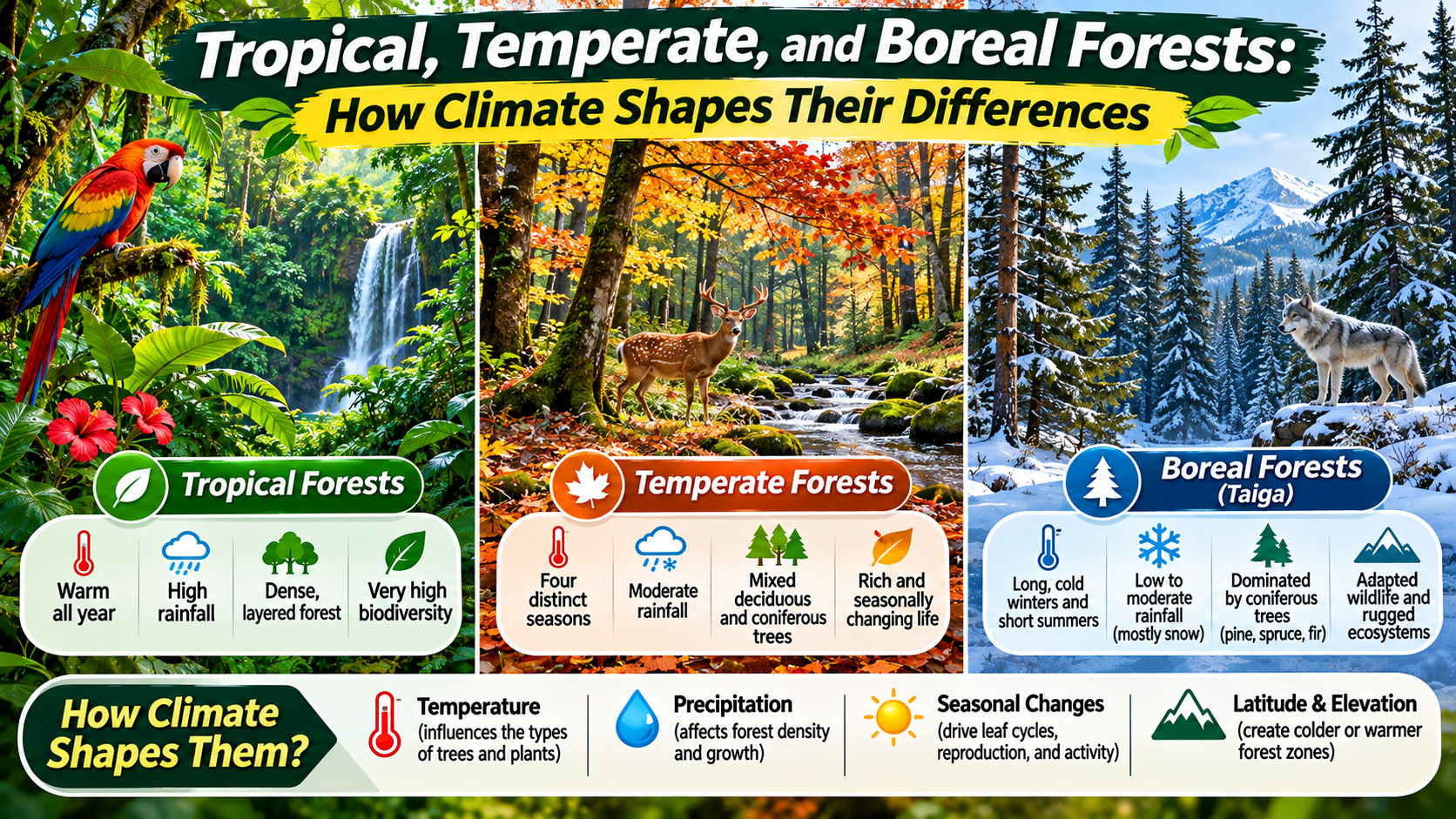
Scientists commonly describe three broad forest biome groups: tropical forests, temperate forests, and boreal forests.
Each group contains considerable variation, but comparing them reveals how climate shapes forest structure, biodiversity, wildlife adaptations, and ecological processes.
This guide explores the major differences between these forest types and explains why protecting each one matters.
What Determines the Type of Forest in a Region?
The distribution of forests is closely connected to climate.
Climate refers to the long-term patterns of temperature, precipitation, and other atmospheric conditions experienced in a location.
Several environmental factors are especially important for forests.
Temperature
Temperature influences photosynthesis, plant growth, and the length of the growing season.
Warm conditions can support year-round growth when sufficient water and nutrients are available.
Cold conditions may limit growth to a short summer period.
Rainfall and Water Availability
Trees require water for photosynthesis, nutrient transport, and other biological processes.
Regions with abundant rainfall may support dense forests, while prolonged dry periods can favor trees with water-conserving adaptations.
Rainfall distribution throughout the year can be just as important as the annual total.
Seasonal Changes
Some forests experience relatively stable temperatures throughout the year.
Others have distinct growing and dormant seasons.
These patterns influence leaf production, flowering, seed development, and wildlife behavior.
Geography and Elevation
Latitude influences sunlight and seasonal temperature patterns, but elevation also matters.
Mountain forests can experience cooler conditions than nearby lowland forests.
Ocean currents, local topography, and prevailing winds can further influence forest climates.
KEY ECOLOGICAL PRINCIPLE
Climate shapes the possibilities for forest life.
Temperature and moisture influence which tree species can grow, how quickly organic matter decomposes, and which animals can survive in a forest ecosystem.
1. Tropical Forests: Warmth, Moisture, and Extraordinary Biodiversity
FOREST TYPE 01 · TROPICAL
The Forests of the Warm Latitudes
Tropical forests develop mainly in regions where temperatures remain relatively warm throughout the year. Rainfall patterns determine whether these forests are evergreen, seasonal, or adapted to extended dry periods.
Tropical forests are found primarily between the Tropic of Cancer and the Tropic of Capricorn.
Major examples occur in South America, Central Africa, Southeast Asia, and parts of Central America.
Many people associate tropical forests with dense rainforests, but tropical forests include several distinct ecosystems.
Tropical rainforests receive substantial rainfall, while tropical seasonal and dry forests experience more pronounced periods of limited precipitation.
Climate Characteristics
Temperatures in tropical lowland forests generally remain warm throughout the year.
Compared with forests at higher latitudes, annual temperature variation is often relatively small.
However, precipitation varies considerably.
Some tropical forests receive frequent rainfall, while others experience a distinct wet season and dry season.
These differences strongly influence vegetation and seasonal growth.
Tree Growth and Forest Structure
Many tropical rainforests have complex vegetation structures.
Tall emergent trees rise above a dense canopy, while smaller trees and shrubs grow beneath them.
The forest floor often receives limited direct sunlight because much of the light is intercepted by the canopy.
Climbing plants and epiphytes may be common in humid tropical environments.
Forest structure varies with rainfall, soil conditions, elevation, and disturbance history.
Wildlife and Biodiversity
Tropical rainforests are especially well known for their high species richness.
They support numerous insects, birds, mammals, reptiles, amphibians, fungi, and plants.
Depending on the region, wildlife may include monkeys, toucans, hornbills, frogs, large cats, and countless invertebrates.
Many organisms occupy specialized ecological niches within different forest layers.
These relationships contribute to the complexity of tropical forest ecosystems.
Tropical Forest Soils
Warm and moist conditions can support rapid decomposition.
However, many tropical rainforest soils are heavily weathered and relatively low in certain nutrients.
Nutrients may cycle quickly between decomposing organic matter and living vegetation.
Soil fertility differs between regions, particularly where geology and flooding influence nutrient availability.
2. Temperate Forests: The Ecosystems of Changing Seasons
FOREST TYPE 02 · TEMPERATE
Forests Shaped by Seasonal Rhythms
Temperate forests occur mainly in middle latitudes, where seasonal temperature changes influence tree growth, wildlife activity, and the availability of food and water.
Temperate forests occur across parts of Europe, North America, East Asia, southern South America, Australia, and New Zealand.
These forests include deciduous woodlands, evergreen forests, mixed forests, and temperate rainforests.
Some temperate forests experience cold winters and warm summers.
Others, particularly near oceans, have milder temperatures and high rainfall.
Climate and Seasonal Variation
Many temperate forests experience recognizable spring, summer, autumn, and winter seasons.
Temperature changes influence when trees produce leaves, flowers, and seeds.
Some temperate forests receive precipitation throughout the year, while others have distinct wetter and drier periods.
Regional climate differences create a wide variety of temperate forest communities.
Deciduous and Evergreen Vegetation
Temperate deciduous forests contain trees that shed their leaves seasonally.
Oaks, maples, beeches, and other broadleaf species are common in many regions.
Leaf shedding helps trees cope with periods when environmental conditions make maintaining foliage less beneficial.
Other temperate forests contain evergreen conifers or broadleaf evergreen trees.
Mixed forests support combinations of deciduous and evergreen species.
Wildlife Adaptations
Temperate forest animals must respond to seasonal changes in temperature and food availability.
Some birds migrate during colder months.
Some mammals enter periods of dormancy or reduce activity.
Other species remain active throughout the year and adjust their diets or behavior.
Depending on the region, temperate forests support deer, foxes, squirrels, woodland birds, amphibians, and many invertebrates.
Soils and Nutrient Cycling
Seasonal leaf fall contributes organic matter to the forest floor.
Fungi, bacteria, and soil animals help decompose this material.
Decomposition rates vary with temperature, moisture, and soil conditions.
Some temperate forests develop fertile soils, while others occur on nutrient-poor or acidic substrates.
3. Boreal Forests: Surviving the Cold Northern Climate
FOREST TYPE 03 · BOREAL
The Great Northern Forest
Boreal forests, also called taiga, extend across high northern latitudes and are shaped by long winters, short growing seasons, and vegetation adapted to cold environments.
Boreal forests stretch across large areas of Canada, Alaska, Scandinavia, and Russia.
They form one of the world’s largest terrestrial biomes.
These forests experience long, cold winters and relatively short summers.
Although they may appear uniform from a distance, boreal landscapes contain different forest communities, lakes, wetlands, and peatlands.
Temperature and Growing Season
Cold temperatures are a defining characteristic of boreal climates.
Winters are often prolonged, while summers provide a relatively short period suitable for plant growth.
Snow cover, frozen soils, and seasonal daylight patterns influence ecological processes.
These conditions limit the types of trees that can survive.
Coniferous Trees
Many boreal forests are dominated by conifers such as spruce, pine, and fir.
Their needle-like leaves and other adaptations help them tolerate challenging environmental conditions.
Evergreen foliage allows some species to begin photosynthesis when conditions become favorable without first producing a new set of leaves.
Boreal forests also contain deciduous species such as birch, aspen, and larch.
Wildlife in Boreal Forests
Boreal animals face cold temperatures and substantial seasonal changes in food availability.
Depending on the region, wildlife may include moose, wolves, lynx, bears, snowshoe hares, and migratory birds.
Some animals develop thick winter coats.
Others change their behavior, food sources, or seasonal movements.
Many migratory birds use boreal forests as breeding habitats during warmer months.
Soils and Peatlands
Cold temperatures can slow decomposition.
Organic matter may accumulate over long periods, particularly in waterlogged peatlands.
Some boreal regions contain permafrost, although it is not present throughout the entire biome.
These soil conditions contribute to the importance of boreal ecosystems in long-term carbon storage.
Tropical vs. Temperate vs. Boreal Forests: Comparison Table
| Feature | Tropical Forest | Temperate Forest | Boreal Forest |
|---|---|---|---|
| Location | Low latitudes | Middle latitudes | High northern latitudes |
| Temperature | Generally warm year-round | Seasonally variable | Long, cold winters |
| Rainfall | From very wet to strongly seasonal | Varies by region | Often relatively low precipitation |
| Growing Season | Often long | Seasonal | Generally short |
| Vegetation | Diverse tropical trees | Deciduous and evergreen trees | Conifers and cold-adapted deciduous trees |
| Biodiversity | Often very high | Varies by location | Generally fewer tree species |
| Decomposition | Often rapid in warm, moist conditions | Strongly seasonal | Often slower in cold conditions |
These are broad ecological patterns. Individual forests may differ because of elevation, rainfall, soil, disturbance history, and regional geography.
How Climate Influences Forest Biodiversity
Biodiversity describes the variety of living organisms in an ecosystem.
Climate influences biodiversity by affecting habitat conditions, energy availability, water supply, and ecological interactions.
Many tropical rainforests support exceptionally high species richness.
Warm conditions, abundant moisture, and complex forest structures can provide numerous ecological niches.
Temperate forests experience stronger seasonal changes that influence reproduction, migration, and food availability.
Boreal forests generally contain fewer tree species than tropical rainforests but support extensive habitats for cold-adapted wildlife and migratory birds.
Species richness is not the only measure of ecological value.
Every forest type contributes important habitats and ecosystem functions.
Why Forest Layers Differ Across Climate Zones
Forest structure reflects the growth patterns of trees and other vegetation.
Many tropical rainforests contain tall emergent trees, dense canopies, and shaded understories.
Temperate forests may also have multiple vegetation layers, but their appearance can change significantly throughout the year.
Some boreal forests have relatively simple tree canopies, with important ground vegetation such as mosses, lichens, shrubs, and small plants.
However, forest structure also depends on age, disturbance, soil conditions, and local climate.
Older forests may develop large trees, standing dead wood, canopy gaps, and other features that support wildlife.
The Importance of Forests in the Carbon Cycle
Forests absorb carbon dioxide during photosynthesis and store carbon in living vegetation, dead organic matter, and soils.
The amount and location of carbon storage vary between forest ecosystems.
Tropical Forest Carbon Storage
Tropical forests can store substantial amounts of carbon in trees and other vegetation.
Deforestation and degradation can release stored carbon and reduce future carbon uptake.
Temperate Forest Carbon Storage
Temperate forests store carbon in trees, roots, dead wood, and soils.
Storage changes with forest age, management, disturbances, and environmental conditions.
Boreal Forest Carbon Storage
Boreal ecosystems contain large carbon stores in soils, peatlands, and vegetation.
Cold conditions can slow decomposition and allow organic matter to accumulate over long periods.
Warming temperatures, wildfires, and changes in frozen ground can affect these carbon reserves.
How Climate Change Affects Forest Ecosystems
Climate change can influence temperature, precipitation, growing seasons, and disturbance patterns.
Its effects differ across forest regions.
Tropical Forests
Some tropical forests face increased heat stress, changing rainfall patterns, and more severe drought conditions.
These changes may affect tree growth, species distributions, and fire risk.
Deforestation and habitat fragmentation can increase environmental pressures.
Temperate Forests
Temperate forests may experience changes in seasonal timing, drought, pest activity, and wildfire conditions.
Some tree species may become less suited to parts of their existing ranges.
Others may expand into newly suitable environments.
Boreal Forests
High northern latitudes have experienced substantial warming.
Changes in wildfire regimes, insect outbreaks, permafrost conditions, and tree growth can influence boreal ecosystems.
Forest boundaries and species composition may shift in some locations over time.
Why Protecting All Three Forest Types Matters
Tropical, temperate, and boreal forests provide different but equally important ecological benefits.
Tropical forests support exceptional biodiversity and influence water and carbon cycles.
Temperate forests provide habitats, protect watersheds, store carbon, and support human communities.
Boreal forests contain extensive carbon-rich soils and provide important breeding habitats for migratory birds.
Conservation strategies should reflect the ecological conditions of each region.
Protecting intact forests, restoring degraded ecosystems, reducing deforestation, and managing disturbances appropriately can contribute to forest conservation.
There is no single management strategy that works equally well in every forest biome.
Frequently Asked Questions
What is the main difference between tropical, temperate, and boreal forests?
The main differences involve climate, especially temperature, rainfall, and seasonality. These conditions influence vegetation, wildlife, biodiversity, and growing seasons.
Which forest type has the highest biodiversity?
Tropical rainforests generally support exceptionally high species richness, although biodiversity varies within every forest category.
Why do temperate forests change color in autumn?
In many temperate deciduous trees, seasonal changes trigger the breakdown of chlorophyll, allowing other leaf pigments to become visible.
Why are boreal forests dominated by conifers?
Many conifers have adaptations that help them survive cold climates and short growing seasons, although boreal forests also contain deciduous trees.
Are all tropical forests rainforests?
No. Tropical forests include rainforests, seasonal forests, and dry forests with different rainfall patterns.
Where are boreal forests located?
Boreal forests occur mainly across northern Canada, Alaska, Scandinavia, and Russia.
Which forests store the most carbon?
Carbon storage depends on forest area, vegetation, soils, and local conditions. Tropical forests store substantial carbon in biomass, while boreal ecosystems contain important soil and peat carbon reserves.
How does climate change affect forests?
Climate change can influence temperature, rainfall, drought, wildfire patterns, pests, growing seasons, and the geographic distribution of tree species.
Final Thoughts
Tropical, temperate, and boreal forests demonstrate how climate shapes ecosystems across the planet.
Tropical forests are generally associated with warm conditions and, in many regions, extraordinary biodiversity.
Temperate forests experience seasonal changes that influence tree growth and wildlife behavior.
Boreal forests survive long, cold winters and support distinctive northern ecosystems with important carbon stores.
Despite their differences, all three forest categories play essential roles in supporting wildlife, regulating environmental processes, and maintaining ecological diversity.
Understanding their climates helps explain why forests differ in appearance, structure, and ecological function.
It also highlights why forest conservation must account for local conditions rather than treating every forest as the same environment.
THE FOREST BIOME TAKEAWAY
Warm Tropical Forests. Seasonal Temperate Forests. Cold Boreal Forests.
Climate influences where forests grow, which species thrive, and how these ecosystems function across the Earth.