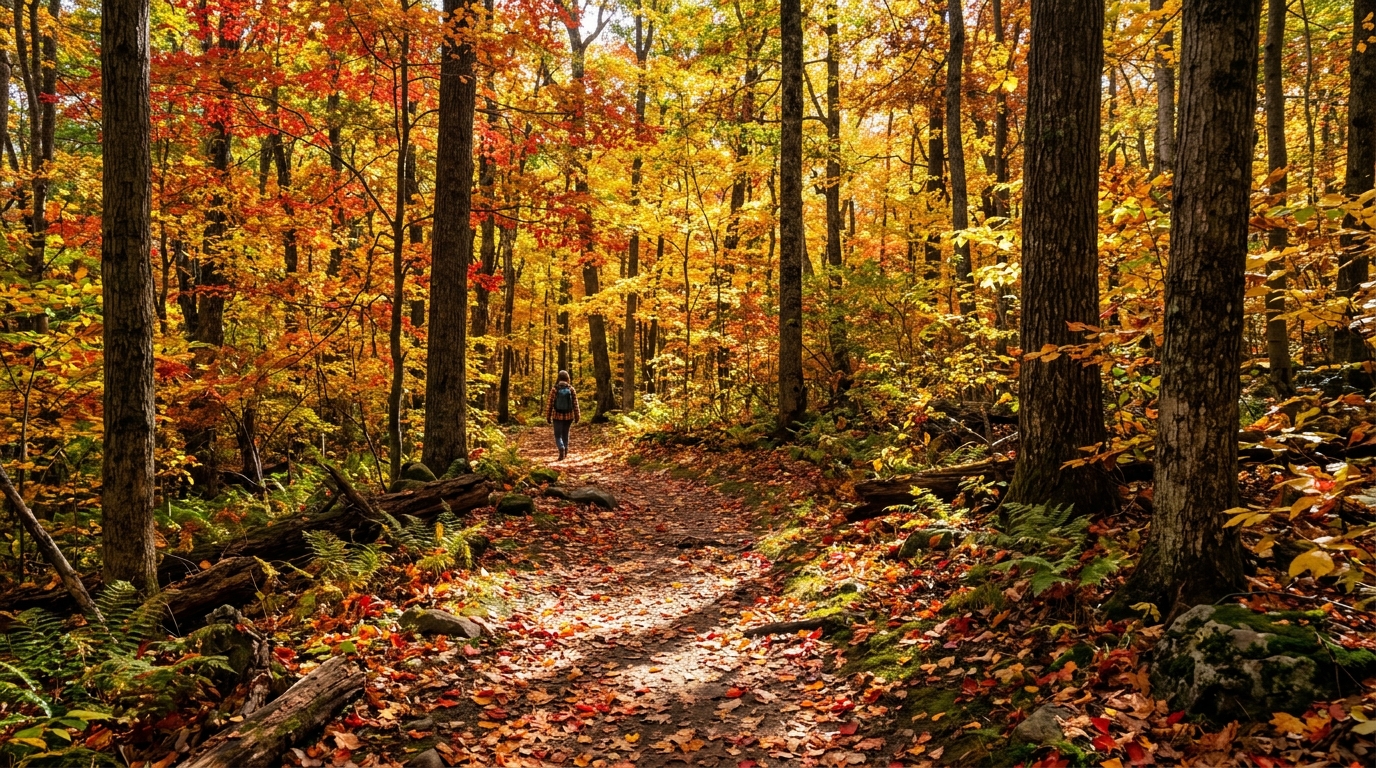
Temperate deciduous forests represent one of the world’s most dynamic and visually striking biomes. Spanning North America, Europe, and East Asia, these biomes are distinguished by broadleaved hardwood trees that drop their foliage in autumn as an evolutionary strategy to withstand sub-freezing winters, fostering exceptionally fertile brown earth soils and complex multi-layered ecosystems.
Temperate deciduous forests occupy regions with distinct four-season climatic cycles, moderate rainfall, and substantial temperature swings between summer heat and winter freezing. Unlike the perpetual growing season of tropical biomes or the brutal, uniform dormancy of the boreal taiga, temperate deciduous ecosystems are defined by rhythm, transition, and adaptability.
Dominated by iconic broadleaf hardwoods including oaks (Quercus), maples (Acer), beeches (Fagus), and chestnuts (Castanea), these forests have co-evolved with fluctuating environmental pressures. In this article, we delve deeply into the physiological mechanisms of seasonal leaf senescence, analyze soil fertility dynamics, chart structural canopy strata, and evaluate the modern ecological pressures confronting these historic woodlands.
1. Global Distribution and Environmental Boundaries
Temperate deciduous biomes are located primarily in mid-latitude zones between approximately 30° and 55° North and South of the equator. The largest contiguous expanses occur across:
- Eastern North America: From southern Canada down through the Appalachian Mountains to the southeastern United States, featuring hyper-diverse cove hardwood communities.
- Western and Central Europe: Stretching from the British Isles across France, Germany, and Poland into western Russia, characterized by extensive beech-oak associations.
- East Asia: Dominating northeastern China, the Korean Peninsula, Japan, and the Russian Far East, known for harboring ancient relict floral genera that survived Pleistocene glaciations.
- Southern Hemisphere Disjunctions: Smaller, distinct counterparts occur in southern Chile (Valdivian temperate forests) and southeastern Australia/New Zealand, dominated by southern beeches (Nothofagus).
These zones experience mean annual temperatures between 10°C and 20°C (50°F to 68°F), accompanied by well-distributed precipitation ranging from 750 to 1,500 mm annually. Crucially, precipitation falls reliably across all four seasons, preventing prolonged arid droughts and sustaining high canopy vigor.
2. Phenology and the Physiology of Leaf Abscission
The term ‘deciduous’ derives from the Latin decidere, meaning ‘to fall off’. Shedding broad leaves annually is not a sign of botanical weakness, but a masterstroke of evolutionary survival. Broad leaves present an immense surface area that, during freezing winters, would lose critical water through transpirational desiccation when frozen soils prevent root moisture uptake. Furthermore, snow loading on flat, broad foliage would shatter heavy wooden branches.
The Biochemical Cascade of Autumn Coloration
As autumnal photoperiods shorten and temperatures decline, trees initiate programmed leaf senescence through a series of tightly regulated biochemical events:
- Chlorophyll Degradation: The energetic cost of maintaining green chlorophyll pigments exceeds photosynthetic return. Trees stop synthesizing chlorophyll, leading to the rapid breakdown of existing green molecules.
- Carotenoid Unmasking: With chlorophyll vanished, pre-existing accessory pigments like carotenoids (beta-carotene) and xanthophylls become visible, bathing the forest canopy in brilliant yellows and vibrant oranges.
- Anthocyanin Synthesis: Certain species (such as red maples and scarlet oaks) actively manufacture red and purple anthocyanin pigments in autumn. These pigments serve as sunscreens and antioxidants, shielding senescing leaves from light damage while the tree reabsorbs valuable nitrogen, phosphorus, and potassium into its trunk and roots.
- Abscission Zone Formation: A specialized double layer of suberin and pectin cells develops at the petiole base (abscission zone). Enzymes dissolve the middle lamella between cells, allowing gentle winds to sever the leaf while sealing the wound with a waterproof, protective cork scar.
3. Forest Stratification: Four Adaptive Strata
The interior architecture of a temperate deciduous forest changes drastically across seasons, allowing varied plant communities to exploit different temporal windows of light and resources:
Canopy and Sub-Canopy Architecture
The mature upper canopy rises 25 to 35 meters, creating an interlocking ceiling of broad foliage throughout summer. Dominant species include white oak (Quercus alba), sugar maple (Acer saccharum), European beech (Fagus sylvatica), and sweet chestnut. Directly below, smaller understory trees such as flowering dogwood (Cornus florida), redbud (Cercis canadensis), and shadbush thrive in dappled light conditions.
The Shrub Layer and Spring Ephemeral Ground Cover
The forest floor hosts one of nature’s most fascinating ecological guilds: spring ephemerals. Plants such as trilliums, bloodroot, wild leeks, and bluebells take advantage of a brief 4 to 6-week window in early spring when temperatures warm but tree canopies have not yet unfurled their leaves. These forest-floor herbs surge through the ground, photosynthesize intensely in direct sunlight, flower, set seeds, and store sugars in underground bulbs or rhizomes before disappearing beneath deep summer canopy shade.
4. Soil Pedogenesis: The Fertile Alfisols and Brown Earths
Unlike the acidic, leached soils of conifer forests or the nutrient-drained soils of tropical basins, temperate deciduous forest floors produce some of the most naturally fertile soils on Earth, known scientifically as Alfisols or brown forest earths (cambisols).
Each autumn, millions of metric tons of nutrient-rich broad leaves blanket the ground. Because temperatures in these regions drop in winter but warm significantly in spring and summer, decomposers operate at an ideal balance. Earthworms, millipedes, fungal decomposers, and soil microbes consume the leaf litter and blend it deep into the mineral soil. This biological bioturbation creates a thick, dark, crumbly organic horizon (mull humus) teeming with exchangeable bases such as calcium, potassium, and magnesium.
5. Ecological Pressures and Conservation Imperatives
Because temperate deciduous forests occupy regions with temperate climates and fertile soils, they have historically been among the most extensively cleared biomes on Earth to make way for human agriculture, urban sprawl, and industrialization. Today, secondary growth dominates, but severe contemporary threats persist:
- Invasive Pathogens and Pests: Introduced diseases have devastated cornerstone species. Notable catastrophes include the chestnut blight (Cryphonectria parasitica), Dutch elm disease, the emerald ash borer (Agrilus planipennis), and beech bark disease.
- Overabundant Ungulate Herbivory: The regional extirpation of apex predators (such as grey wolves and cougars) has allowed white-tailed deer populations to explode. Extreme browsing pressure strips native understory saplings, halts oak regeneration, and promotes unpalatable invasive weeds like Japanese stiltgrass.
- Atmospheric Nitrogen Deposition: Industrial emissions deposit excess airborne nitrogen, which acidifies forest soils, alters mycorrhizal communities, and degrades native plant diversity.
6. Frequently Asked Questions (FAQs)
Q1: Why do broadleaf trees drop their leaves instead of keeping them all winter?
Broad leaves have a large surface area and delicate tissues vulnerable to freezing temperatures and winter moisture loss. When the ground freezes, roots cannot absorb liquid water. If broad leaves remained attached, dry winter winds would draw out all moisture, causing lethal desiccation. Dropping leaves preserves internal water and prevents heavy winter snowfall from snapping limbs.
Q2: How do animals in temperate forests adapt to extreme seasonal shifts?
Fauna employ three primary strategies: migration (songbirds travel south to tropical zones), hibernation (bears, chipmunks, and bats enter states of torpor with depressed metabolic rates), and food hoarding (squirrels and jays cache acorns and beechnuts to sustain themselves through snowy months).
Q3: What makes spring ephemerals unique in these ecosystems?
Spring ephemerals exploit a distinct ecological temporal niche. They awaken and complete their entire vegetative and reproductive lifecycle during the brief window between snowmelt and tree canopy leaf-out, capitalizing on unhindered solar radiation before the forest canopy closes.
Temperate deciduous forests are masterclasses in biological timing and resilience. Their annual rhythm of leaf loss, winter dormancy, and vernal resurgence creates fertile soils and complex multi-layered habitats. Conserving mature secondary stands, managing deer populations, and combating exotic pathogens are essential to ensure the longevity of these remarkable woodlands.
7. Dendrochronology and Paleoclimatic Signatures in Deciduous Hardwoods
The annual growth rings of temperate broadleaf trees represent nature’s environmental archives. Because temperate trees undergo strict winter dormancy, each spring brings a rapid burst of wide, thin-walled xylem vessels (earlywood or springwood) to transport massive sap volumes. As summer turns to autumn, growth slows, producing narrow, thick-walled cells (latewood or summerwood). This sharp transition creates distinct annual rings that provide invaluable scientific records:
- Paleoclimatic Reconstructions: Tree-ring widths correlate with historical precipitation and drought indices. Dendrochronologists examining ancient white oaks (Quercus alba) have reconstructed North American and European drought cycles spanning over 1,500 years, revealing mega-droughts that influenced historic crop failures and human migrations.
- Wildfire History (Fire Scars): Periodic surface fires leave localized cambial scars without killing mature thick-barked hardwoods. By cross-dating fire scars across multiple trees, scientists determine natural pre-industrial fire return intervals.
8. Keystone Hardwood Mast Cycles: The Oak-Acorn Complex
One of the most consequential ecological phenomena in temperate deciduous forests is mast seeding. Hardwood trees—particularly oaks (Quercus), American beech (Fagus grandifolia), and hickories (Carya)—do not produce steady crops of nuts each autumn. Instead, they produce modest crops for several consecutive years, followed by a synchronous, regional ‘mast year’ where trees drop hundreds of thousands of nutrient-rich acorns per hectare.
This boom-and-bust cycle represents an evolutionary strategy known as predator satiation. By producing far more acorns than local squirrels, deer, bears, and mice can possibly consume, oaks ensure that millions of acorns survive to germinate. However, the subsequent winter triggers immense rodent population explosions, followed by pulses of tick-borne pathogens and surges in hawk, owl, and fox populations, demonstrating how a botanical reproductive rhythm ripples through the entire regional food web.
9. Global Comparative Case Studies and Field Methodologies
Scientific exploration of Temperate Deciduous Forests: Seasonal Cycles, Canopy Architecture, and Ecological Resilience requires examining long-term empirical field data across diverse continents. Over the past five decades, ecological research stations—such as the Smithsonian Tropical Research Institute, the Long Term Ecological Research (LTER) network, and the European FluxNet system—have gathered millions of quantitative data points that demonstrate how microclimates, species interactions, and human pressures reshape habitat integrity over time.
Standardized field methodologies involve combining permanent forest dynamic plots (typically 50-hectare research quadrats where every tree exceeding 1 cm in diameter is tagged, mapped, and monitored) with eddy covariance flux towers. These towers rise high above forest canopies, measuring the continuous net ecosystem exchange (NEE) of carbon dioxide, water vapor, and heat fluxes between vegetation and the atmosphere at 20-millisecond frequencies, providing absolute empirical confirmation of planetary climate buffering.
Quantitative Field Metrics and Monitoring Parameters
10. Multilateral Policy Frameworks and 2030 Sustainable Development Goals
Preserving the integrity of Temperate Deciduous Forests: Seasonal Cycles, Canopy Architecture, and Ecological Resilience is intrinsically linked to achieving the United Nations 2030 Sustainable Development Goals (SDGs), particularly SDG 13 (Climate Action), SDG 14 (Life Below Water), and SDG 15 (Life on Land). International conventions, including the Convention on Biological Diversity (CBD) and the United Nations Framework Convention on Climate Change (UNFCCC), now mandate that national ecological action plans formally account for ecosystem services within gross domestic accounting systems.
Furthermore, the emergence of the Taskforce on Nature-related Financial Disclosures (TNFD) is revolutionizing corporate environmental responsibility. Multinational financial institutions and corporations are now legally required to assess, disclose, and actively mitigate their physical supply chain dependencies on wild ecosystems. By aligning private capital allocation with ecological regeneration, humanity is establishing the financial foundations necessary to ensure long-term evolutionary equilibrium across all global biomes.
Addressing the challenges outlined in ‘Temperate Deciduous Forests: Seasonal Cycles, Canopy Architecture, and Ecological Resilience’ demands a unified three-tiered approach: (1) Immediate legal moratoriums on industrial land conversion in primary frontier wildernesses; (2) Sovereign debt restructuring through debt-for-nature swaps that empower local conservation trusts; and (3) Scaling high-integrity biodiversity credits that directly fund local Indigenous communities and frontline conservation stewards.
In addition to technological monitoring and multilateral treaties, grassroots environmental education serves as the vital cultural catalyst for enduring change. When local communities and academic institutions establish participatory citizen-science observatories, community members actively participate in biodiversity monitoring, water chemistry sampling, and phenological tracking. This democratic approach to scientific discovery transforms local populations from passive observers into passionate, empowered guardians of their ancestral natural heritage.
As we navigate the ecological challenges of the Anthropocene, the choice before humanity is clear: we can continue the trajectory of short-sighted industrial exploitation that destabilizes our planet’s life-support machinery, or we can embrace a profound ecological renaissance rooted in scientific rigor, Indigenous wisdom, and restorative environmental ethics. By protecting intact habitats, restoring degraded landscapes, and honoring the intricate ecological networks that bind all living creatures, we secure a flourishing, biodiverse Earth for generations to come.