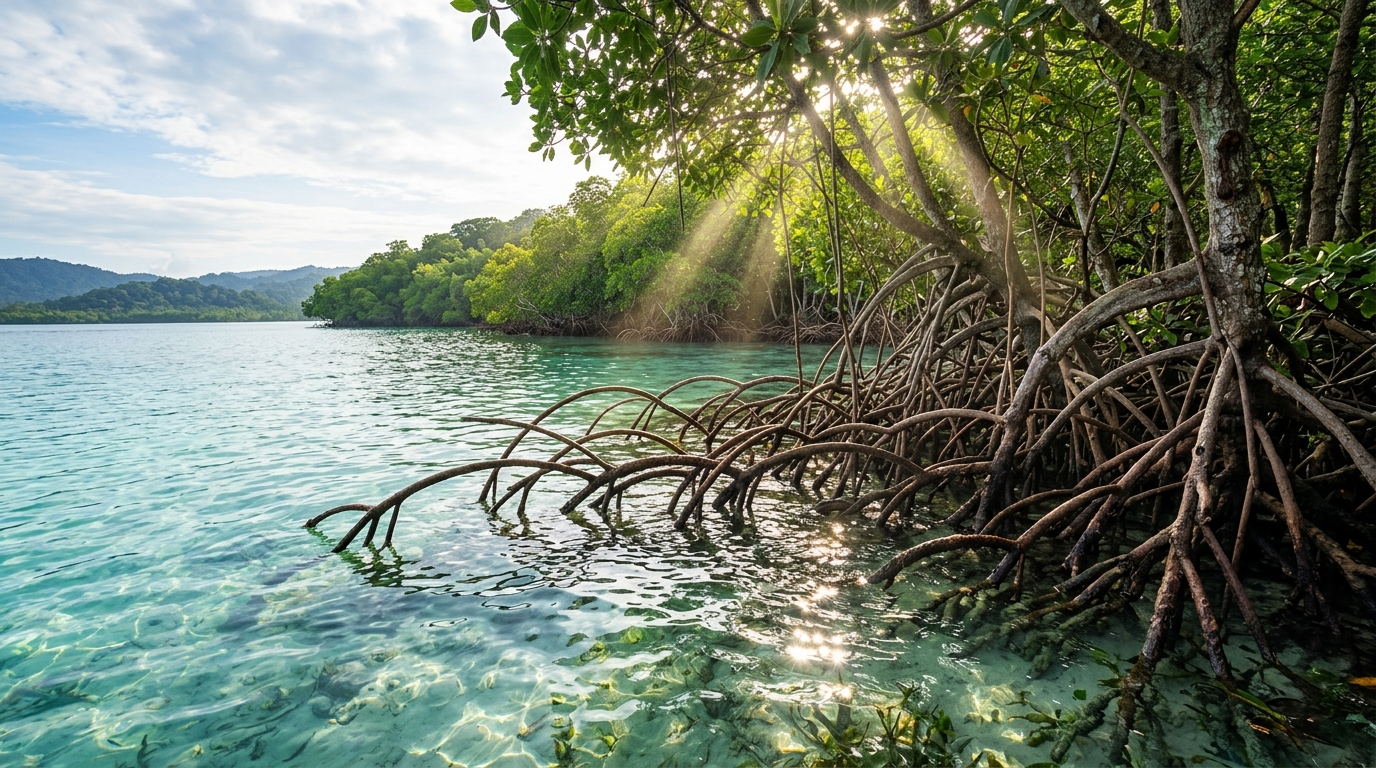
At the extreme margins where land meets sea and where mountains kiss the sky, two of the planet’s most specialized woodland ecosystems thrive: coastal mangroves and montane cloud forests. Though occupying vastly different elevations, both biomes are shaped by hydrological immersion, harboring unique endemic species, defending shorelines, and harvesting atmospheric moisture with extraordinary efficiency.
While mainstream ecological discussions often focus on expansive lowland rainforests or vast conifer belts, Earth’s specialized boundary woodlands demonstrate the outer limits of botanical adaptation. Coastal mangrove forests bridge the marine and terrestrial realms along tropical shores, while montane cloud forests (nebelwald) inhabit high-altitude ridges blanketed in perpetual mist.
Despite their limited global footprint, these two biomes provide outsized ecosystem services. Mangroves are our premier marine nurseries and coastal storm buffers, while cloud forests capture invisible aerial moisture to feed continental watersheds. In this comprehensive guide, we examine the physiological adaptations, endemic biodiversity, carbon sequestration prowess, and modern conservation challenges of these delicate environmental sentinels.
1. Coastal Mangroves: Masters of Intertidal Salinity and Anoxia
Mangrove forests thrive in intertidal zones of tropical and subtropical coastlines between 30° North and 30° South. Constantly inundated by tides, lashed by storm surges, and rooted in suffocating anaerobic mud, mangrove trees have developed remarkable physiological adaptations to thrive where conventional trees wither.
Halophytic Adaptations: Conquering Toxic Salinity
Seawater contains salt concentrations that would dehydrate and poison ordinary plants. Mangroves conquer this barrier through three distinct strategies:
- Salt Ultra-Filtration: Species like the red mangrove (Rhizophora mangle) possess specialized semi-permeable membranes in their roots that filter out over 90% to 97% of sodium and chloride ions via reverse osmosis before sap enters the vascular system.
- Salt Secretion: Black mangroves (Avicennia germinans) absorb saline water and actively pump excess salt out through specialized microscopic glands on their leaves. On sunny days, visible white salt crystals glisten across their foliage.
- Tissue Accumulation: White mangroves (Laguncularia racemosa) isolate excess salts within old, senescing leaves or bark, shedding them to purge accumulated toxins from the plant body.
Root Architecture: Stilt Roots and Pneumatophores
Intertidal mud is saturated with water and virtually devoid of oxygen. To breathe, red mangroves deploy extensive arched ‘prop’ or ‘stilt’ roots that emerge high on tree trunks, looping down into the substrate. These exposed roots feature porous lenticels that draw in atmospheric oxygen during low tide and transport it through spongy aerenchyma tissues to subterranean roots.
Black mangroves employ vertical pencil-like root structures called pneumatophores. Thousands of these woody snorkels shoot upward 10 to 30 cm from the underground root system, piercing the mud surface to exchange gases when tides recede.
2. Montane Cloud Forests: Harvesting Atmospheric Mist
Perched high along tropical mountain ranges—typically between 1,000 and 3,000 meters above sea level—tropical montane cloud forests exist in a dreamlike twilight of perpetual fog, high humidity, and cool temperatures. Famous examples include Costa Rica’s Monteverde Cloud Forest, the Andean yungas, and the misty ridges of Mount Kinabalu in Borneo.
The Phenomenon of Horizontal Precipitation
In cloud forests, rainfall alone does not tell the full hydrological story. The most critical water input occurs through horizontal precipitation (occult precipitation). As moist trade winds strike mountain slopes, air parcels rise, cool, and condense into thick clouds. The dense surfaces of cloud forest vegetation—covered with millions of epiphytic bromeliads, mosses, liverworts, and ferns—act as fine nets that intercept airborne water droplets directly from passing fog.
This intercepted moisture condenses on leaves and continuously drips to the forest floor, contributing up to 30% to 50% more freshwater to regional river networks than recorded rainfall alone. In this manner, cloud forests function as natural hydrological sponges, releasing clean water slowly into downstream valleys throughout dry periods.
3. Ecological Comparison: Mangroves vs. Cloud Forests
Despite their geographical contrast, comparing these two boundary ecosystems highlights the astonishing adaptability of forest life across Earth’s topographic extremes:
4. Blue Carbon and Ecosystem Value of Mangrove Buffers
Mangroves are among the most carbon-dense ecosystems on the planet, sequestering up to four to ten times more carbon per hectare than terrestrial tropical rainforests—a capacity termed Coastal Blue Carbon. The dense root matrices trap organic sediment, while saline, waterlogged mud inhibits microbial oxidation, locking carbon away for millennia.
Beyond carbon storage, mangroves serve as nature’s coastal armor. Complex stilt roots attenuate over 60% of wave energy within the first 100 meters of forest width, shielding coastal communities from devastating tsunamis, cyclones, and erosion. Simultaneously, these root labyrinths shelter juvenile fish, crabs, and shrimp from marine predators, supporting over 80% of global tropical commercial fisheries.
5. Existential Threats and Preservation Imperatives
Both ecosystems face grave risks driven by human alteration:
- Shrimp Aquaculture and Coastal Hardening: Over 35% of global mangrove forests have been bulldozed for industrial shrimp farms and coastal real estate developments over the past four decades.
- The ‘Lifting Cloud Base’ Syndrome: Global atmospheric warming pushes cloud condensation levels higher up mountain slopes. Consequently, cloud forests are drying out as fog banks no longer envelope the mountain ridges, driving sensitive mountaintop species (like the golden toad) to extinction.
- Road Construction and Fragmentation: High-altitude roads dissect cloud forest watersheds, triggering destructive landslides and creating conduits for invasive pests and agricultural encroachment.
6. Frequently Asked Questions (FAQs)
Q1: What is ‘vivipary’ in mangrove reproduction?
Vivipary is a remarkable reproductive adaptation where seeds germinate while still attached to the parent tree. The developing embryo grows into a long, dart-shaped propagule. When mature, it drops into the water. If the tide is out, it plunges directly into soft mud and takes root immediately; if the tide is in, it floats horizontally for months across ocean currents until it touches a sandbank and anchors vertically.
Q2: Why are trees in cloud forests often gnarled and covered in moss?
Cloud forest trees encounter constant strong mountain winds, low solar radiation due to cloud cover, cold temperatures, and acidic soils. These factors slow tree growth, producing short, twisted, gnarled trunks. Perpetual high humidity allows mosses, liverworts, and orchids to blanket every square inch of bark without risk of drying out.
Q3: Can mangroves survive sea level rise?
Mangroves can survive gradual sea level rise if they have sufficient sediment supply to build up soil elevation or space to migrate inland. However, where sea walls, highways, and towns block inland migration (a dilemma called ‘coastal squeeze’), rising tides will submerge their breathing roots, causing widespread die-offs.
Mangrove woodlands and montane cloud forests represent life’s supreme adaptation to moisture extremes. Mangroves filter oceans, protect shorelines, and lock away carbon, while cloud forests capture aerial fog to feed continental river basins. Safeguarding these boundary biomes is fundamental to coastal protection and freshwater security worldwide.
7. Endemism in Montane Cloud Forests: Living Evolutionary Laboratories
Because tropical cloud forests occupy isolated mountain peaks separated by warm, dry lowland valleys, they function ecologically as sky islands. Species adapted to cool, saturated mountain ridges cannot migrate across hot valleys, leading to explosive, localized speciation and extraordinary rates of endemism:
- The Resplendent Quetzal (Pharomachrus mocinno): Revered by the ancient Maya and Aztec civilizations, this magnificent trogon lives exclusively in the montane cloud forests of Central America. It depends on wild avocados of the family Lauraceae, swallowing fruits whole and regurgitating the large seeds, functioning as the primary dispersal vector for ancient cloud forest trees.
- Epiphytic Orchid Radiation: The cloud forests of Ecuador and Colombia harbor more than 4,000 species of orchids. Specialized genera like Dracula (monkey orchids) produce intricate floral structures that mimic decomposing woodland fungi in odor and visual appearance, duping fungus gnats into performing pollination without offering nectar rewards.
- Plethodontid Salamanders: Lungless salamanders breathe entirely through their thin, permeable skin, which requires 100% relative humidity to exchange gases. Cloud forest moss cushions provide the perpetual moisture necessary for these amphibians to thrive high above sea level.
8. Blue Carbon Economics: Valuing Mangrove Conservation over Aquaculture
Historically, coastal developers cleared mangrove forests for industrial shrimp aquaculture, claiming shrimp farming generated superior economic profits. However, modern environmental resource economics has exposed the fatal financial flaws of this short-sighted calculation:
- Short Commercial Lifespan: Intensive commercial shrimp ponds accumulate toxic antibiotic residues, unconsumed feed, and bacterial pathogens, forcing operators to abandon the ponds after just 3 to 6 years of production.
- Loss of Coastal Storm Defense: Intact mangroves provide an estimated $65 billion per year in flood and storm protection globally. When mangroves are destroyed, a single hurricane or tsunami inflicts billions of dollars in coastal infrastructure damage that dwarfs the transient profits of shrimp farming.
- Carbon Credit Markets: In international voluntary carbon markets, coastal blue carbon offsets from preserved mangroves command premium prices ($15 to $35 per metric ton of CO2 equivalent) because they combine high-density carbon sequestration with community poverty reduction and marine biodiversity conservation.
9. Global Comparative Case Studies and Field Methodologies
Scientific exploration of Cloud Forests and Mangrove Woodlands: Specialized Coastal and High-Altitude Ecosystems requires examining long-term empirical field data across diverse continents. Over the past five decades, ecological research stations—such as the Smithsonian Tropical Research Institute, the Long Term Ecological Research (LTER) network, and the European FluxNet system—have gathered millions of quantitative data points that demonstrate how microclimates, species interactions, and human pressures reshape habitat integrity over time.
Standardized field methodologies involve combining permanent forest dynamic plots (typically 50-hectare research quadrats where every tree exceeding 1 cm in diameter is tagged, mapped, and monitored) with eddy covariance flux towers. These towers rise high above forest canopies, measuring the continuous net ecosystem exchange (NEE) of carbon dioxide, water vapor, and heat fluxes between vegetation and the atmosphere at 20-millisecond frequencies, providing absolute empirical confirmation of planetary climate buffering.
Quantitative Field Metrics and Monitoring Parameters
10. Multilateral Policy Frameworks and 2030 Sustainable Development Goals
Preserving the integrity of Cloud Forests and Mangrove Woodlands: Specialized Coastal and High-Altitude Ecosystems is intrinsically linked to achieving the United Nations 2030 Sustainable Development Goals (SDGs), particularly SDG 13 (Climate Action), SDG 14 (Life Below Water), and SDG 15 (Life on Land). International conventions, including the Convention on Biological Diversity (CBD) and the United Nations Framework Convention on Climate Change (UNFCCC), now mandate that national ecological action plans formally account for ecosystem services within gross domestic accounting systems.
Furthermore, the emergence of the Taskforce on Nature-related Financial Disclosures (TNFD) is revolutionizing corporate environmental responsibility. Multinational financial institutions and corporations are now legally required to assess, disclose, and actively mitigate their physical supply chain dependencies on wild ecosystems. By aligning private capital allocation with ecological regeneration, humanity is establishing the financial foundations necessary to ensure long-term evolutionary equilibrium across all global biomes.
Addressing the challenges outlined in ‘Cloud Forests and Mangrove Woodlands: Specialized Coastal and High-Altitude Ecosystems’ demands a unified three-tiered approach: (1) Immediate legal moratoriums on industrial land conversion in primary frontier wildernesses; (2) Sovereign debt restructuring through debt-for-nature swaps that empower local conservation trusts; and (3) Scaling high-integrity biodiversity credits that directly fund local Indigenous communities and frontline conservation stewards.
In addition to technological monitoring and multilateral treaties, grassroots environmental education serves as the vital cultural catalyst for enduring change. When local communities and academic institutions establish participatory citizen-science observatories, community members actively participate in biodiversity monitoring, water chemistry sampling, and phenological tracking. This democratic approach to scientific discovery transforms local populations from passive observers into passionate, empowered guardians of their ancestral natural heritage.
As we navigate the ecological challenges of the Anthropocene, the choice before humanity is clear: we can continue the trajectory of short-sighted industrial exploitation that destabilizes our planet’s life-support machinery, or we can embrace a profound ecological renaissance rooted in scientific rigor, Indigenous wisdom, and restorative environmental ethics. By protecting intact habitats, restoring degraded landscapes, and honoring the intricate ecological networks that bind all living creatures, we secure a flourishing, biodiverse Earth for generations to come.