Covering a mere 2.5% of Earth’s total terrestrial surface, the world’s 36 recognized Biodiversity Hotspots harbor over 50% of the world’s endemic plant species and nearly 43% of all terrestrial vertebrates. Defined by extreme biological uniqueness combined with severe anthropogenic destruction, these regions represent our highest-priority targets for global conservation funding and immediate ecological intervention.
Conservation biologists frequently face a harsh logistical reality: financial resources, personnel, and institutional capabilities for environmental protection are strictly limited, whereas the pace of planetary habitat destruction is accelerating. To maximize the effectiveness of every dollar and protected area designation, scientists prioritize areas that harbor the greatest concentration of irreplaceable species under the most immediate threat of annihilation.
This strategic approach gave birth to the concept of Biodiversity Hotspots. Conceptualized by British ecologist Norman Myers in 1988 and formalized by Conservation International, hotspot science provides an indispensable analytical framework for spatial conservation prioritization. In this exhaustive guide, we examine the quantitative criteria required for hotspot designation, profile the planet’s most critical endemic epicenters, analyze the mechanisms of extinction vulnerability, and chart practical conservation blueprints for the future.
1. The Myers Quantitative Criteria: Defining a Biodiversity Hotspot
An area cannot be designated as a biodiversity hotspot simply because it is picturesque or contains popular wildlife. To qualify under the rigorous scientific standards established by Norman Myers and Conservation International, a biogeographic region must satisfy two strict, quantitative benchmarks:
- Criterion 1: Irreplaceable Endemism: The region must contain at least 1,500 species of vascular plants found nowhere else on Earth (endemic species). Vascular plants serve as the foundational primary producers that underpin all terrestrial animal life; therefore, high botanical endemism reliably indicates hyper-specialized faunal communities.
- Criterion 2: Extreme Threat and Habitat Loss: The region must have lost at least 70% of its original natural primary vegetation. In other words, 30% or less of the native habitat remains intact, signifying that the ecosystem is teetering on the precipice of total irreversible collapse.
To date, scientists have formally designated 36 global biodiversity hotspots. While their combined remaining intact territory constitutes just 2.5% of Earth’s landmass, losing these fragments would cause the extinction of more than half of all planetary species.
2. Profile of the World’s Most Critical Biodiversity Hotspots
A. The Tropical Andes: The Global Epicenter of Endemism
Stretching across seven South American nations along the spine of the Andes mountain range, the Tropical Andes is universally recognized as the single most biodiverse hotspot on Earth. The complex vertical topography—ranging from sea-level coastal plains to snow-capped peaks exceeding 6,000 meters—creates millions of isolated microclimates and deep river valleys that have acted as natural speciation engines.
The Tropical Andes contains an estimated 30,000 species of vascular plants, of which over 50% (15,000 species) are strict endemics found nowhere else. It is home to nearly 1,000 amphibian species (with two-thirds being endemic), hundreds of unique hummingbirds, the endangered spectacled bear (Tremarctos ornatus), and the Andean condor. The region faces severe pressures from illegal gold mining, cattle grazing, coca cultivation, and infrastructure expansion.
B. Madagascar and the Indian Ocean Islands: An Evolutionary Micro-Continent
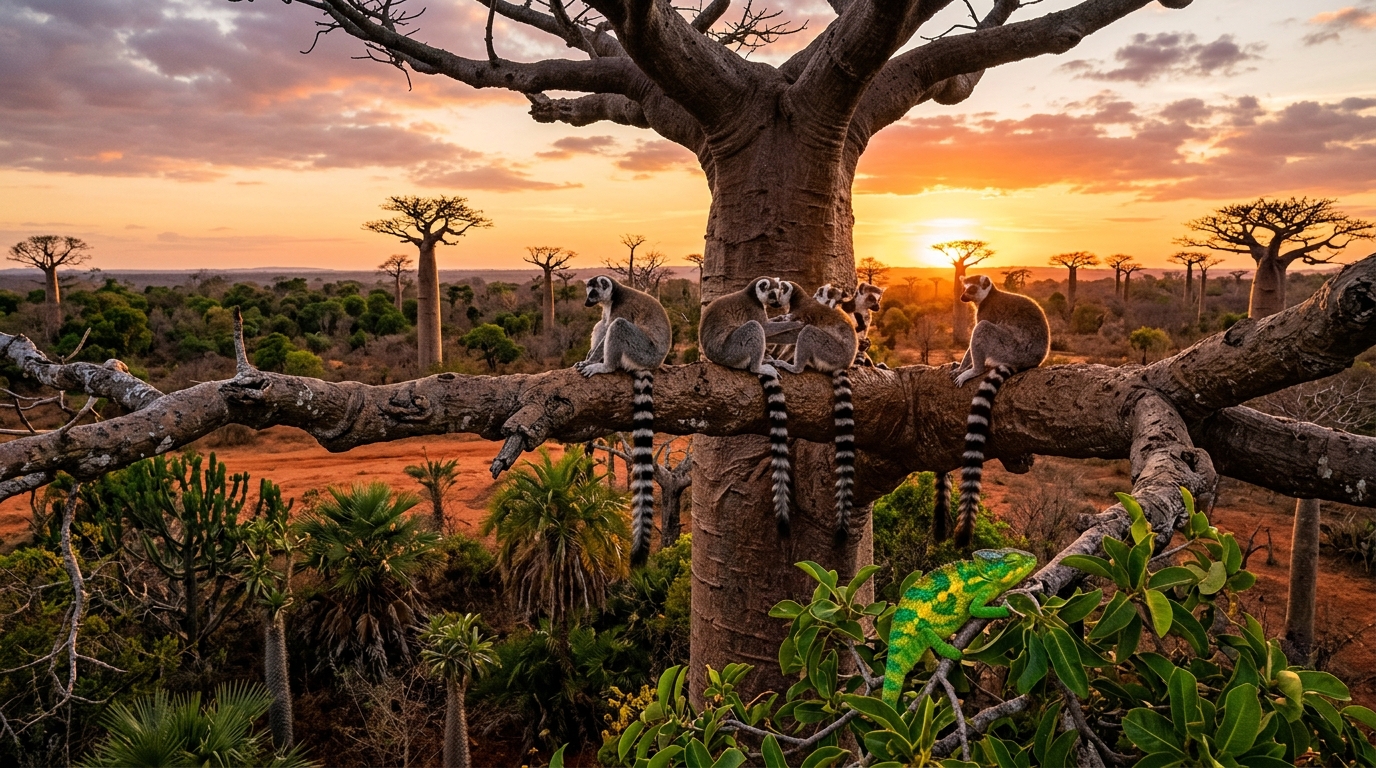
Having broken away from the Gondwana supercontinent over 88 million years ago, Madagascar has evolved in deep oceanic isolation, functioning essentially as a separate micro-continent. Over 90% of all plant and animal species on Madagascar are found nowhere else on Earth.
Madagascar is the exclusive homeland of all lemurs (over 100 surviving species of primates found exclusively on the island), the cat-like fossa predator, two-thirds of the world’s chameleon species, and six out of the world’s eight baobab species. Tragically, slash-and-burn agriculture (tavy), charcoal production, and illegal rosewood logging have destroyed over 85% of the island’s native forests, pushing dozens of lemur species into critically endangered status.
C. The Western Ghats and Sri Lanka: Asia’s Ancient Monsoon Ridge
Paralleling the western coast of the Indian peninsula, the Western Ghats intercept moisture-laden southwest monsoon winds, generating lush evergreen rainforests and high-altitude shola grasslands. The region is home to over 5,000 vascular plant species, 139 mammal species, and more than 500 bird species.
The Western Ghats are internationally renowned for their extraordinary amphibian endemism. In 2003, biologists discovered the purple frog (Nasikabatrachus sahyadrensis)—a bizarre burrowing amphibian representing a ‘living fossil’ lineage that diverged from other frogs over 130 million years ago. Severe human population density, tea and coffee plantations, hydroelectric dams, and linear transport corridors heavily fragment this critical mountain belt.
D. Sundaland and Wallacea: The Island Crucible of Speciation
Covering the islands of Borneo, Sumatra, Java, and the Malay Peninsula, Sundaland was repeatedly connected to continental Asia during Ice Age glacial sea-level drops. Dominated by massive dipterocarp forests, Sundaland is home to iconic megafauna: the Sumatran and Bornean orangutans, the critically endangered Sumatran rhinoceros, the Asian elephant, and the world’s largest individual flower, Rafflesia arnoldii.
The region is bounded to the east by the famous Wallace Line—a deep marine trench that marks the sharp evolutionary boundary between Asian placental fauna and Australian marsupial fauna, creating the adjacent hotspot of Wallacea.
Comparative Matrix: Key Global Biodiversity Hotspots
3. Why Are Endemic Species Uniquely Vulnerable to Extinction?
Hotspot species are not simply rare; they possess biological traits that make them hypersensitive to disturbance:
- Hyper-Localized Geographic Ranges: Many hotspot endemics inhabit a single mountain peak, a solitary limestone cave system, or a specific river valley. A single mining project or forest fire can eradicate the entire global population of a species in an afternoon.
- Specialized Symbiotic Dependencies: Many plants in hotspots rely on a single, specific animal vector for pollination or seed dispersal. If the animal disappears, the plant becomes an ‘evolutionary ghost’—unable to reproduce sexually.
- Lack of Behavioral Anti-Predator Defenses (Island Endemics): Having evolved in isolated environments free from placental carnivores, island endemics like the flightless birds of New Zealand and Mauritius developed ‘island tameness’, making them easy prey for introduced rats, cats, and pigs.
4. Strategic Priority Conservation Blueprints
Halting extinction across global hotspots requires targeted, high-impact conservation frameworks:
- Expanding Key Biodiversity Areas (KBAs): Establishing rigorously protected reserves around sites that hold the last remaining populations of critically endangered endemic species.
- Biological Corridors and Landscape Matrix Permeability: Connecting fragmented forest patches with wildlife corridors so that isolated animal populations can interbreed and exchange genetic alleles.
- Community-Led Conservation Stewardship: Aligning conservation incentives with local community livelihoods through ecotourism revenue-sharing, sustainable agroforestry, and formal legal recognition of ancestral land rights.
- Debt-for-Nature Swaps: Restructuring international sovereign debt in exchange for enforceable, permanent government commitments to finance hotspot biodiversity trusts.
5. Frequently Asked Questions (FAQs)
Q1: Who first developed the biodiversity hotspot concept?
The concept was developed in 1988 by British ecologist Norman Myers in two landmark papers. Myers recognized that environmental degradation was uneven across the globe, and argued that protecting small regions of extraordinary plant endemism facing extreme threats would yield the highest return on investment for global conservation.
Q2: Why are vascular plants used as the primary benchmark instead of animals?
Vascular plants are the primary producers that define terrestrial habitat structure and food availability for all herbivorous and carnivorous animals. Furthermore, plant distributions are generally more thoroughly mapped and taxonomically described, making them reliable surrogates for overall biodiversity.
Q3: Does the Amazon rainforest qualify as a biodiversity hotspot?
Surprisingly, under the strict Myers definition, the main Amazon basin is classified as a ‘High-Biodiversity Wilderness Area’ rather than a hotspot. While its endemism is immense, over 75% to 80% of the overall Amazon forest currently remains standing, meaning it has not yet crossed the 70% habitat loss threshold required for formal hotspot designation (unlike the Atlantic Forest of Brazil, which has lost over 88% and is a critical hotspot).
Global Biodiversity Hotspots represent the frontline of planetary conservation. By focusing global ecological resources on the 2.5% of Earth’s surface where over half of all endemic life is concentrated, humanity has an extraordinary opportunity to prevent catastrophic mass extinction and safeguard the living jewels of our planet.
9. Global Comparative Case Studies and Field Methodologies
Scientific exploration of Global Biodiversity Hotspots: Critical Endemic Regions, Threats, and Conservation Priorities requires examining long-term empirical field data across diverse continents. Over the past five decades, ecological research stations—such as the Smithsonian Tropical Research Institute, the Long Term Ecological Research (LTER) network, and the European FluxNet system—have gathered millions of quantitative data points that demonstrate how microclimates, species interactions, and human pressures reshape habitat integrity over time.
Standardized field methodologies involve combining permanent forest dynamic plots (typically 50-hectare research quadrats where every tree exceeding 1 cm in diameter is tagged, mapped, and monitored) with eddy covariance flux towers. These towers rise high above forest canopies, measuring the continuous net ecosystem exchange (NEE) of carbon dioxide, water vapor, and heat fluxes between vegetation and the atmosphere at 20-millisecond frequencies, providing absolute empirical confirmation of planetary climate buffering.
Quantitative Field Metrics and Monitoring Parameters
10. Multilateral Policy Frameworks and 2030 Sustainable Development Goals
Preserving the integrity of Global Biodiversity Hotspots: Critical Endemic Regions, Threats, and Conservation Priorities is intrinsically linked to achieving the United Nations 2030 Sustainable Development Goals (SDGs), particularly SDG 13 (Climate Action), SDG 14 (Life Below Water), and SDG 15 (Life on Land). International conventions, including the Convention on Biological Diversity (CBD) and the United Nations Framework Convention on Climate Change (UNFCCC), now mandate that national ecological action plans formally account for ecosystem services within gross domestic accounting systems.
Furthermore, the emergence of the Taskforce on Nature-related Financial Disclosures (TNFD) is revolutionizing corporate environmental responsibility. Multinational financial institutions and corporations are now legally required to assess, disclose, and actively mitigate their physical supply chain dependencies on wild ecosystems. By aligning private capital allocation with ecological regeneration, humanity is establishing the financial foundations necessary to ensure long-term evolutionary equilibrium across all global biomes.
Addressing the challenges outlined in ‘Global Biodiversity Hotspots: Critical Endemic Regions, Threats, and Conservation Priorities’ demands a unified three-tiered approach: (1) Immediate legal moratoriums on industrial land conversion in primary frontier wildernesses; (2) Sovereign debt restructuring through debt-for-nature swaps that empower local conservation trusts; and (3) Scaling high-integrity biodiversity credits that directly fund local Indigenous communities and frontline conservation stewards.
In addition to technological monitoring and multilateral treaties, grassroots environmental education serves as the vital cultural catalyst for enduring change. When local communities and academic institutions establish participatory citizen-science observatories, community members actively participate in biodiversity monitoring, water chemistry sampling, and phenological tracking. This democratic approach to scientific discovery transforms local populations from passive observers into passionate, empowered guardians of their ancestral natural heritage.
As we navigate the ecological challenges of the Anthropocene, the choice before humanity is clear: we can continue the trajectory of short-sighted industrial exploitation that destabilizes our planet’s life-support machinery, or we can embrace a profound ecological renaissance rooted in scientific rigor, Indigenous wisdom, and restorative environmental ethics. By protecting intact habitats, restoring degraded landscapes, and honoring the intricate ecological networks that bind all living creatures, we secure a flourishing, biodiverse Earth for generations to come.