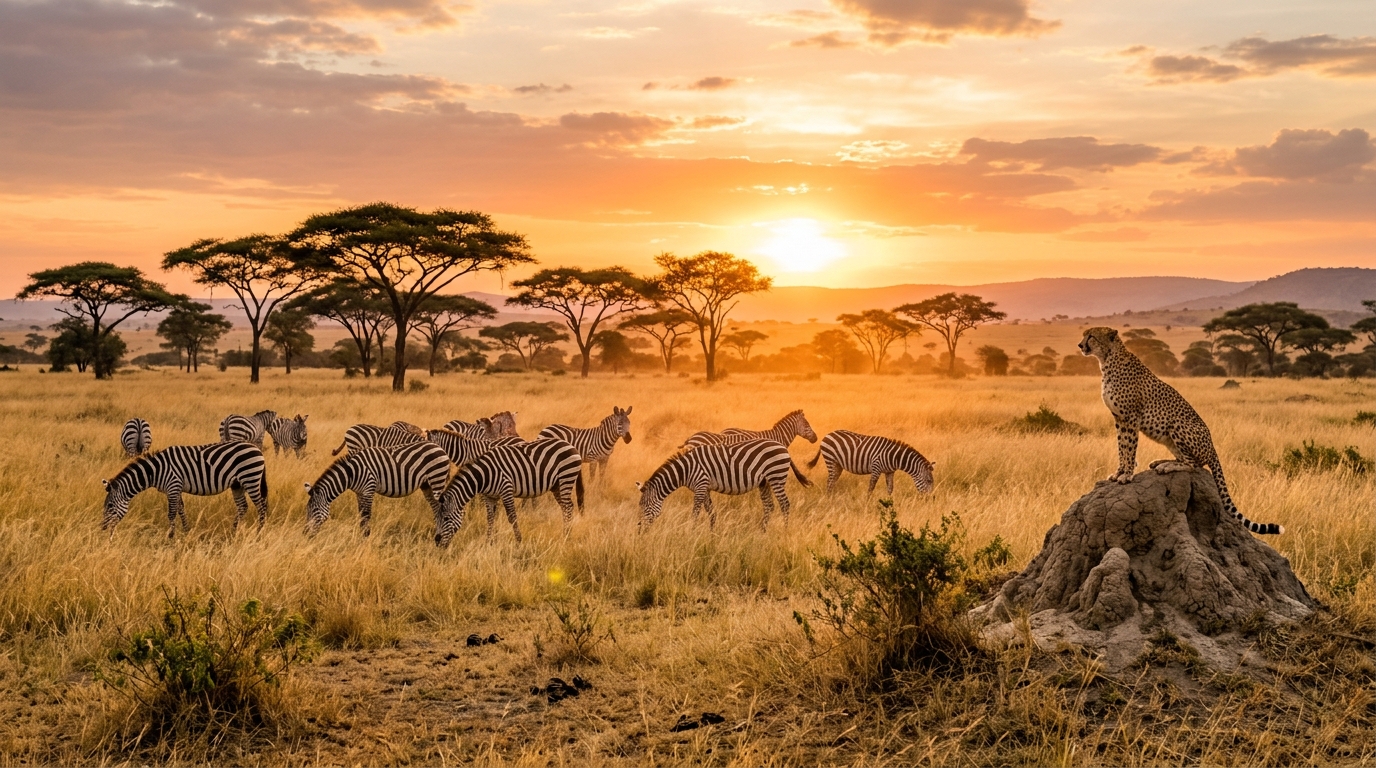
Every living organism is an open thermodynamic system that requires continuous energetic inputs to maintain structural order, fuel cellular metabolism, and reproduce. In ecology, trophic levels delineate the stepwise passage of chemical energy from primary producers up to apex carnivores. Governed strictly by the laws of thermodynamics, energy transfer between levels is notoriously inefficient—typically transferring only 10% of energy—which sets physical limits on the architecture of all planetary food chains.
Why are large predatory animals like tigers, eagles, and killer whales so exceedingly rare compared to grasshoppers, trees, and krill? Why are there no super-predators that feed exclusively on lions and polar bears? The answers to these fundamental ecological questions do not lie in animal behavior, but in the immutable laws of physics and chemical thermodynamics.
In this authoritative guide, we deconstruct ecological bioenergetics, examine the First and Second Laws of Thermodynamics as they apply to living systems, dissect Raymond Lindeman’s landmark 10% Ecological Efficiency Rule, contrast pyramids of energy, numbers, and biomass, and investigate the dangerous phenomenon of biological biomagnification.
1. The Thermodynamic Laws Governing Ecological Energetics
Biological ecosystems are not exempt from the physical laws that govern the universe. Energy flows through ecosystems in accordance with two fundamental principles of classical thermodynamics:
- The First Law of Thermodynamics (Conservation of Energy): Energy can neither be created nor destroyed; it can only be transformed from one physical state to another. In ecosystems, solar radiant energy (photons) is captured by photosynthetic pigments and converted into potential chemical energy stored within the covalent bonds of organic glucose molecules (C6H12O6). The total quantity of energy entering the biological system must exactly equal the total energy stored plus energy dissipated.
- The Second Law of Thermodynamics (Entropy Increase): In every energetic transformation, some energy is inevitably degraded into an unusable, disordered form—primarily low-grade thermal heat that radiates out into space. No biological conversion is 100% efficient. When a herbivore eats a plant, only a small fraction of the ingested energy is synthesized into new herbivore muscle and bone; the vast majority is lost as metabolic heat during cellular respiration, locomotion, digestion, and basal maintenance.
2. Defining Trophic Levels: The Hierarchical Energy Ladder
A trophic level (from the Greek trophe, meaning food or nourishment) reflects an organism’s feeding position within the broader energetic sequence of an ecosystem:
Level 1: Primary Producers (Autotrophs)
Occupying the foundational base of every ecosystem, autotrophs manufacture their own organic matter from inorganic substances. In terrestrial biomes, photoautotrophs (vascular plants, bryophytes) harness sunlight via chlorophyll. In aquatic systems, microscopic phytoplankton (diatoms, dinoflagellates, cyanobacteria) produce the foundational energetic pulse. Around deep-sea hydrothermal vents, chemoautotrophic bacteria synthesize organic molecules by oxidizing hydrogen sulfide without any sunlight.
Level 2: Primary Consumers (Herbivores)
Organisms that feed directly on autotrophs are classified as primary consumers. Because plant tissues are dominated by tough cellulose and lignin, herbivores possess specialized digestive adaptations: multi-chambered rumens in cows and deer containing symbiotic anaerobic bacteria, elongated caecums in rabbits and horses, or specialized radulae in herbivorous snails.
Level 3: Secondary Consumers (Primary Carnivores)
Secondary consumers are predatory or insectivorous animals that prey upon herbivores. Examples include insect-eating warblers, frogs consuming grasshoppers, small snakes consuming herbivorous rodents, and zooplankton-eating forage fish like sardines.
Level 4 & 5: Tertiary Consumers and Apex Predators
Tertiary consumers prey upon secondary carnivores (e.g., a hawk that eats a snake that ate a mouse). At the absolute summit of the food chain sit apex predators—carnivores that have no natural predators of their own within that ecosystem (such as the orca, Siberian tiger, polar bear, and saltwater crocodile).
3. Lindeman’s 10% Rule: Why Food Chains Are Strictly Limited in Length
In 1942, limnologist Raymond Lindeman published a revolutionary paper analyzing Cedar Bog Lake in Minnesota, formulating what is now recognized as Lindeman’s Efficiency / The 10% Ecological Rule. Lindeman demonstrated that, on average, only approximately 10% of the energy stored as biomass in one trophic level is converted into biomass in the next trophic level (with real-world trophic transfer efficiencies typically ranging between 5% and 20%).
Where does the remaining 90% of the energy go? It is accounted for by three primary energetic leaks:
- Respiratory Heat Loss (R): The vast majority of consumed calories are burned during cellular respiration to maintain body temperature (especially in homeothermic mammals and birds), circulate blood, power muscle contractions, and repair cellular damage.
- Unconsumed Biomass: Predators rarely consume 100% of their prey; woody roots, dense bark, hair, claws, feathers, and heavy skeleton bones are left behind.
- Fecal and Excretory Waste (Egestion): Herbivores cannot digest all ingested plant matter. Up to 50% or more of consumed cellulose passes straight through the gut undigested as feces, transferring its energy to decomposers rather than the consumer’s body tissue.
Table: Stepwise Energetic Trophic Dissipation (Hypothetical 1,000,000 Joule Input)
4. Ecological Pyramids: Numbers, Biomass, and Energy
Ecologists represent trophic structures graphically through three types of ecological pyramids first conceptualized by Charles Elton:
- Pyramid of Energy: Always upright, without exception. Because energy is continuously lost as heat (Second Law of Thermodynamics), a higher trophic level can never contain more total energy than the level beneath it.
- Pyramid of Numbers: Graphs the count of individual organisms at each level. Usually upright, but can be inverted in specific ecosystems—for instance, a single massive oak tree (one producer) can support 100,000 herbivorous caterpillars (Level 2), which in turn support 20 songbirds (Level 3).
- Pyramid of Biomass: Measures the total dry weight of living organic tissue at each level. In terrestrial ecosystems, biomass pyramids are strictly upright (forests have vastly more tree mass than herbivore mass). However, in open marine ecosystems, the biomass pyramid is inverted! The standing crop biomass of microscopic phytoplankton is smaller than that of the zooplankton and whales that eat them. How is this possible? Phytoplankton have hyper-rapid turnover rates; they reproduce and divide within hours, generating high productivity that supports a larger standing biomass of long-lived animals.
5. Biomagnification: The Lethal Concentration of Persistent Toxins
While energy decreases as it moves up trophic levels, certain synthetic chemical contaminants do the exact opposite—a deadly ecological phenomenon known as biological biomagnification.
Persistent Organic Pollutants (POPs)—such as DDT, PCBs, dioxins, and methylmercury—are lipophilic (fat-soluble) and cannot be metabolized or excreted by animal kidneys. When a herbivore eats thousands of contaminated plants, it stores all the toxin in its fatty tissues. When a carnivore eats hundreds of herbivores, it concentrates all of their lifetime toxins into its own body. Consequently, toxin concentrations increase exponentially at each ascending trophic level.
This was the catastrophe documented by Rachel Carson in her landmark 1962 book Silent Spring: DDT concentrations in coastal waters were negligible (0.000003 ppm), but by the time the chemical reached apex osprey and bald eagles, it had biomagnified by a factor of over 10 million times, causing eggshell thinning that pushed bald eagles to the brink of extinction.
6. Frequently Asked Questions (FAQs)
Q1: Why can’t a terrestrial food chain have 8 or 9 trophic levels?
Due to the 10% ecological efficiency rule, 90% of energy is lost at each successive step. By the 4th or 5th trophic level, less than 0.01% of the original producer energy remains. There is simply not enough remaining caloric energy left to sustain the hunting metabolism, territorial patrols, and reproduction of a viable population of 6th- or 7th-level carnivores.
Q2: Why is eating at a lower trophic level more environmentally sustainable for humans?
When humans eat primary producers (grains, legumes, vegetables), we capture 10% of the plant’s energy directly. When we feed those grains to livestock and then eat the cattle, 90% of the plant calories were already burned off by the cow’s metabolism. It requires roughly 10 pounds of grain to produce 1 pound of beef, making plant-based consumption substantially more resource-efficient.
Q3: Can an ecological pyramid of energy ever be inverted?
No, an ecological pyramid of energy can never be inverted. To invert an energy pyramid would violate the Second Law of Thermodynamics by having more usable energy generated at a higher level than was supplied by the lower level.
Trophic levels and the 10% ecological efficiency rule establish the energetic laws that structure all biological communities. Because energy dissipates as heat at each transfer, apex predators are inherently rare and vulnerable, while persistent toxins biomagnify to lethal concentrations at the summit of food chains.
9. Global Comparative Case Studies and Field Methodologies
Scientific exploration of Trophic Levels and Energy Transfer: The 10% Ecological Efficiency Rule and Biomass Pyramids requires examining long-term empirical field data across diverse continents. Over the past five decades, ecological research stations—such as the Smithsonian Tropical Research Institute, the Long Term Ecological Research (LTER) network, and the European FluxNet system—have gathered millions of quantitative data points that demonstrate how microclimates, species interactions, and human pressures reshape habitat integrity over time.
Standardized field methodologies involve combining permanent forest dynamic plots (typically 50-hectare research quadrats where every tree exceeding 1 cm in diameter is tagged, mapped, and monitored) with eddy covariance flux towers. These towers rise high above forest canopies, measuring the continuous net ecosystem exchange (NEE) of carbon dioxide, water vapor, and heat fluxes between vegetation and the atmosphere at 20-millisecond frequencies, providing absolute empirical confirmation of planetary climate buffering.
Quantitative Field Metrics and Monitoring Parameters
10. Multilateral Policy Frameworks and 2030 Sustainable Development Goals
Preserving the integrity of Trophic Levels and Energy Transfer: The 10% Ecological Efficiency Rule and Biomass Pyramids is intrinsically linked to achieving the United Nations 2030 Sustainable Development Goals (SDGs), particularly SDG 13 (Climate Action), SDG 14 (Life Below Water), and SDG 15 (Life on Land). International conventions, including the Convention on Biological Diversity (CBD) and the United Nations Framework Convention on Climate Change (UNFCCC), now mandate that national ecological action plans formally account for ecosystem services within gross domestic accounting systems.
Furthermore, the emergence of the Taskforce on Nature-related Financial Disclosures (TNFD) is revolutionizing corporate environmental responsibility. Multinational financial institutions and corporations are now legally required to assess, disclose, and actively mitigate their physical supply chain dependencies on wild ecosystems. By aligning private capital allocation with ecological regeneration, humanity is establishing the financial foundations necessary to ensure long-term evolutionary equilibrium across all global biomes.
Addressing the challenges outlined in ‘Trophic Levels and Energy Transfer: The 10% Ecological Efficiency Rule and Biomass Pyramids’ demands a unified three-tiered approach: (1) Immediate legal moratoriums on industrial land conversion in primary frontier wildernesses; (2) Sovereign debt restructuring through debt-for-nature swaps that empower local conservation trusts; and (3) Scaling high-integrity biodiversity credits that directly fund local Indigenous communities and frontline conservation stewards.
In addition to technological monitoring and multilateral treaties, grassroots environmental education serves as the vital cultural catalyst for enduring change. When local communities and academic institutions establish participatory citizen-science observatories, community members actively participate in biodiversity monitoring, water chemistry sampling, and phenological tracking. This democratic approach to scientific discovery transforms local populations from passive observers into passionate, empowered guardians of their ancestral natural heritage.
As we navigate the ecological challenges of the Anthropocene, the choice before humanity is clear: we can continue the trajectory of short-sighted industrial exploitation that destabilizes our planet’s life-support machinery, or we can embrace a profound ecological renaissance rooted in scientific rigor, Indigenous wisdom, and restorative environmental ethics. By protecting intact habitats, restoring degraded landscapes, and honoring the intricate ecological networks that bind all living creatures, we secure a flourishing, biodiverse Earth for generations to come.