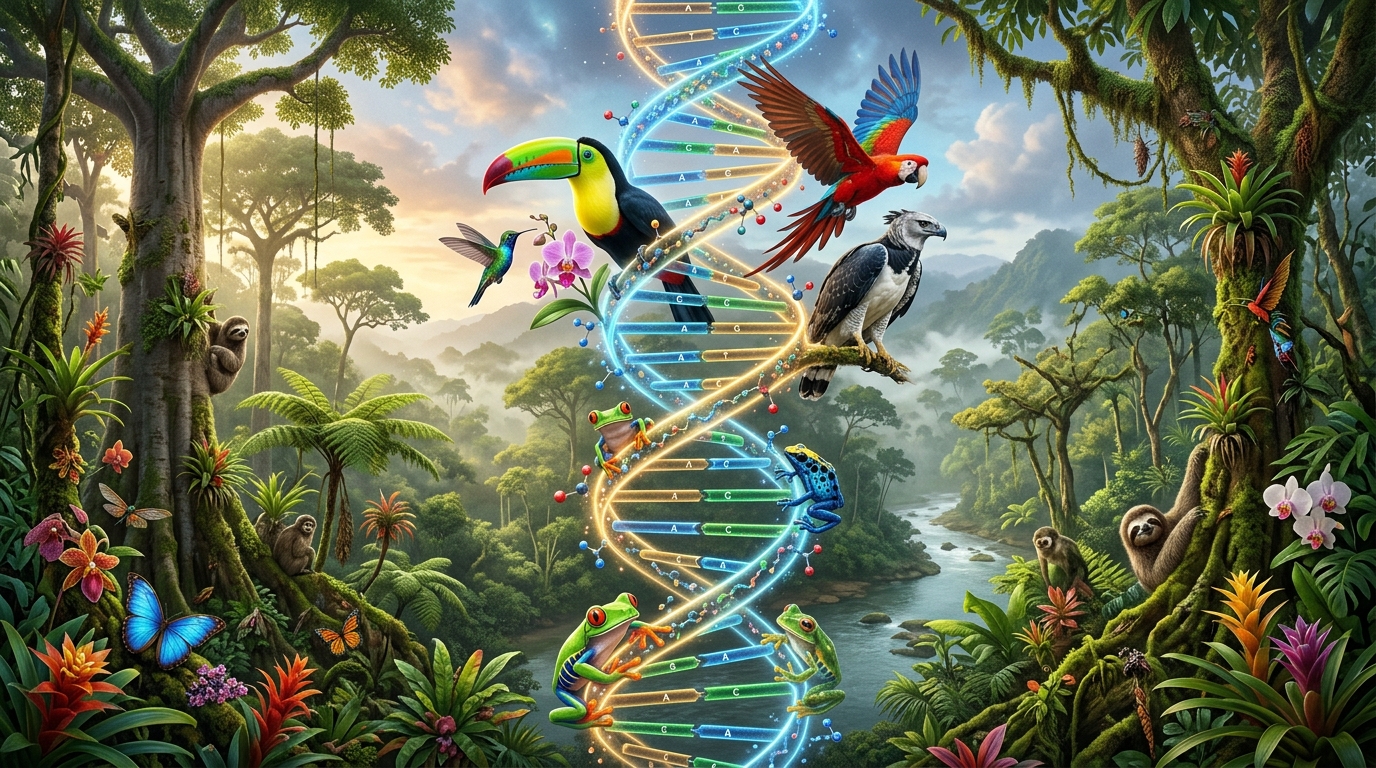
Biological diversity—or biodiversity—is the full spectrum of life on planet Earth, spanning from microscopic nucleotide variations within individual chromosomes to continental biome formations. Understanding biodiversity requires examining its three interdependent hierarchical pillars: Genetic Diversity, Species Diversity, and Ecosystem Diversity. Each pillar provides unique evolutionary resilience that safeguards the biosphere.
Life on Earth is not a static collection of isolated organisms, but an interconnected evolutionary continuum spanning over 3.8 billion years. The term ‘biodiversity’—first coined by entomologist E.O. Wilson and conservation biologists in the 1980s—encompasses every facet of biological variation across space, time, and taxonomy. Rather than treating nature as a uniform green backdrop, biodiversity science reveals that the stability, productivity, and resilience of our planet depend directly on variation at every organizational scale.
In this authoritative guide, we deconstruct the three foundational tiers of biodiversity, investigate the population genetics behind evolutionary adaptability, examine taxonomic richness and functional redundancy, analyze landscape-level biome dynamics, and explore why preserving all three tiers is paramount for the survival of life on Earth.
1. Pillar One: Genetic Diversity (The Foundation of Adaptability)
Genetic diversity refers to the total variety of genetic information contained within the individual organisms of a single species. It manifests as variations in DNA nucleotide sequences, allelic frequencies across populations, and chromosomal structures. Without genetic diversity, natural selection has no raw material upon which to act, leaving populations evolutionarily frozen and vulnerable to extinction.
Consider the evolutionary mechanics of disease resistance. If a wild population of trees possesses high genetic diversity, individual trees carry hundreds of different alleles for immune signaling, pathogen recognition, and defensive chemical synthesis. When a novel fungus strikes the forest, a significant percentage of individuals possess innate genetic resistance, allowing the population to survive and reproduce. Conversely, in a genetically uniform population—such as a clonal agricultural monoculture—a single pathogen can wipe out 100% of the individuals simultaneously.
The Tragic Hazards of Population Bottlenecks and Inbreeding
When habitat destruction, hunting, or natural cataclysms reduce a population to a handful of surviving individuals, the population passes through a genetic bottleneck. Even if numbers subsequently recover, rare alleles are permanently lost, and heterozygosity plummets. This leads to inbreeding depression: the expression of deleterious recessive mutations, skeletal deformities, elevated juvenile mortality, and compromised immune systems.
A classic ecological case study is the African cheetah (Acinonyx jubatus). Geneticists discovered that cheetahs passed through two severe bottlenecks (one approximately 100,000 years ago, and another during the late Pleistocene extinction 10,000 years ago). Today, cheetahs exhibit an astonishing 90% to 99% genetic uniformity—so extreme that skin grafts transferred between unrelated wild cheetahs are accepted without immune rejection, making the species extraordinarily vulnerable to catastrophic pandemics.
2. Pillar Two: Species Diversity (Richness, Evenness, and Functional Guilds)
Species diversity is the most tangible and widely recognized facet of biodiversity. However, ecologists do not quantify it merely by counting the number of species present. Species diversity requires calculating two distinct statistical metrics:
- Species Richness (S): The total absolute count of different biological species co-occurring within a defined geographical area or ecological sample.
- Species Evenness (Equitability): The relative abundance and equitability of individuals among those different species. A forest containing 10 tree species where 99% of trees belong to one species and the remaining 9 species have only one individual has high richness but abysmal evenness, making it ecologically fragile.
The Insurance Hypothesis and Functional Redundancy
Why does species diversity matter beyond sheer aesthetic beauty? Ecologists answer this through the Insurance Hypothesis. In a biodiverse ecosystem, multiple species perform overlapping ecological functions—such as nitrogen fixation, seed dispersal, pollination, or water purification. This overlap is known as functional redundancy.
If an ecosystem contains only one primary pollinator (e.g., a single species of bumblebee) and an invasive parasite wipes out that bee, the entire reproductive cycle of flowering plants collapses. However, if the ecosystem harbors twenty different species of native solitary bees, hoverflies, butterflies, and beetles, the loss of one species is buffered by others that step in to fulfill the pollination role, keeping the ecosystem structurally intact.
3. Pillar Three: Ecosystem Diversity (Landscape Heterogeneity and Biomes)
Ecosystem diversity encompasses the broad variety of habitats, biological communities, and ecological processes occurring across landscapes, seascapes, and biomes. It examines the spatial arrangement and structural heterogeneity of forests, grasslands, rivers, wetlands, coral reefs, estuaries, and alpine meadows.
A landscape with high ecosystem diversity is not a monotonous monoculture; it is a rich mosaic. For example, a river basin that transitions naturally from high-gradient mountain streams to braided gravel beds, oxbow lakes, floodplain marshes, and forested riparian corridors provides specialized niches for thousands of distinct life stages. Migratory birds rely on high ecosystem diversity to find appropriate feeding stopovers, nesting cliffs, and wintering marshes across continental flyways.
The Three Hierarchical Pillars of Biodiversity Compared
4. The Latitudinal Diversity Gradient: Why is the Equator Teeming with Life?
One of the most universal macroecological patterns on Earth is the Latitudinal Diversity Gradient (LDG). Across virtually every taxonomic group—from vascular plants and insects to birds, mammals, and marine organisms—species richness peaks dramatically at the equator and steadily declines toward the poles. What explains this profound biological distribution?
- The Evolutionary Speed Hypothesis: Warm equatorial temperatures accelerate biochemical reaction rates, shorten generation times, and increase mutation rates, driving faster evolutionary divergence and speciation over deep time.
- The Climate Stability and Age Hypothesis: While temperate and polar regions were repeatedly scoured and depopulated by massive Pleistocene ice sheets, tropical equatorial biomes remained comparatively climatically stable for tens of millions of years, allowing continuous speciation without widespread glaciation-driven extinctions.
- The Solar Energy and Kinetic Theory: Equatorial zones receive immense, year-round solar energy. Greater net primary productivity (NPP) provides an abundant energetic foundation, supporting larger populations and finer ecological niche specialization.
5. The Sixth Mass Extinction: The Anthropocene Crisis
In the 4.5-billion-year history of Earth, five major mass extinction events have occurred, each wiping out between 65% and 95% of all living species (such as the Permian-Triassic extinction and the Cretaceous asteroid impact). Today, scientific consensus confirms that Earth has entered its Sixth Mass Extinction—the first in planetary history caused entirely by the activities of a single biological species: Homo sapiens.
Current species extinction rates are estimated to be between 100 and 1,000 times higher than the natural background extinction rate observed in the fossil record. The primary drivers are encapsulated in the scientific acronym HIPPO:
- H – Habitat Loss & Fragmentation: Deforestation, road construction, and agricultural expansion strip wildlife of home ranges.
- I – Invasive Alien Species: Non-native predators and pests disrupt naive evolutionary communities (e.g., brown tree snakes in Guam, feral cats in Australia).
- P – Pollution: Microplastics, synthetic endocrine disruptors, pesticides, and nitrogen runoff toxicify food webs.
- P – Population Growth of Humans: Unsustainable consumption drives escalating extraction of planetary resources.
- O – Overexploitation: Commercial bushmeat hunting, illegal wildlife trade, and industrial overfishing hollow out ecosystems.
6. Frequently Asked Questions (FAQs)
Q1: Can a species have high numbers but low genetic diversity?
Yes. Commercial agricultural crops like Cavendish bananas number in the billions of individual plants worldwide, yet because they are propagated as sterile clones, their genetic diversity is essentially zero. A single virulent soil fungus (Tropical Race 4) can wipe out entire continental plantations because not a single plant carries genetic resistance.
Q2: How does the Shannon-Wiener Diversity Index work?
The Shannon-Wiener Index (H’) calculates the degree of uncertainty in predicting the species identity of an individual randomly selected from a community. It mathematically combines both species richness and species evenness. Higher values of H’ represent diverse, balanced ecosystems, while low values reflect disturbed, monoculture-dominated communities.
Q3: What is the difference between alpha, beta, and gamma diversity?
Alpha diversity measures species richness within a single local site (e.g., one forest patch). Beta diversity measures the turnover or difference in species composition between different sites across a landscape. Gamma diversity measures the total regional biodiversity across an entire geographic landscape or mountain range (combining alpha and beta diversity).
Biodiversity is our planet’s greatest evolutionary legacy and life’s ultimate insurance policy. Conserving genetic diversity ensures species can evolve; preserving species diversity maintains ecosystem functionality; and defending ecosystem diversity safeguards continental biogeochemical stability. Preserving all three pillars is imperative for human survival.
9. Global Comparative Case Studies and Field Methodologies
Scientific exploration of The Three Pillars of Biodiversity: Genetic, Species, and Ecosystem Diversity Explained requires examining long-term empirical field data across diverse continents. Over the past five decades, ecological research stations—such as the Smithsonian Tropical Research Institute, the Long Term Ecological Research (LTER) network, and the European FluxNet system—have gathered millions of quantitative data points that demonstrate how microclimates, species interactions, and human pressures reshape habitat integrity over time.
Standardized field methodologies involve combining permanent forest dynamic plots (typically 50-hectare research quadrats where every tree exceeding 1 cm in diameter is tagged, mapped, and monitored) with eddy covariance flux towers. These towers rise high above forest canopies, measuring the continuous net ecosystem exchange (NEE) of carbon dioxide, water vapor, and heat fluxes between vegetation and the atmosphere at 20-millisecond frequencies, providing absolute empirical confirmation of planetary climate buffering.
Quantitative Field Metrics and Monitoring Parameters
10. Multilateral Policy Frameworks and 2030 Sustainable Development Goals
Preserving the integrity of The Three Pillars of Biodiversity: Genetic, Species, and Ecosystem Diversity Explained is intrinsically linked to achieving the United Nations 2030 Sustainable Development Goals (SDGs), particularly SDG 13 (Climate Action), SDG 14 (Life Below Water), and SDG 15 (Life on Land). International conventions, including the Convention on Biological Diversity (CBD) and the United Nations Framework Convention on Climate Change (UNFCCC), now mandate that national ecological action plans formally account for ecosystem services within gross domestic accounting systems.
Furthermore, the emergence of the Taskforce on Nature-related Financial Disclosures (TNFD) is revolutionizing corporate environmental responsibility. Multinational financial institutions and corporations are now legally required to assess, disclose, and actively mitigate their physical supply chain dependencies on wild ecosystems. By aligning private capital allocation with ecological regeneration, humanity is establishing the financial foundations necessary to ensure long-term evolutionary equilibrium across all global biomes.
Addressing the challenges outlined in ‘The Three Pillars of Biodiversity: Genetic, Species, and Ecosystem Diversity Explained’ demands a unified three-tiered approach: (1) Immediate legal moratoriums on industrial land conversion in primary frontier wildernesses; (2) Sovereign debt restructuring through debt-for-nature swaps that empower local conservation trusts; and (3) Scaling high-integrity biodiversity credits that directly fund local Indigenous communities and frontline conservation stewards.
In addition to technological monitoring and multilateral treaties, grassroots environmental education serves as the vital cultural catalyst for enduring change. When local communities and academic institutions establish participatory citizen-science observatories, community members actively participate in biodiversity monitoring, water chemistry sampling, and phenological tracking. This democratic approach to scientific discovery transforms local populations from passive observers into passionate, empowered guardians of their ancestral natural heritage.
As we navigate the ecological challenges of the Anthropocene, the choice before humanity is clear: we can continue the trajectory of short-sighted industrial exploitation that destabilizes our planet’s life-support machinery, or we can embrace a profound ecological renaissance rooted in scientific rigor, Indigenous wisdom, and restorative environmental ethics. By protecting intact habitats, restoring degraded landscapes, and honoring the intricate ecological networks that bind all living creatures, we secure a flourishing, biodiverse Earth for generations to come.