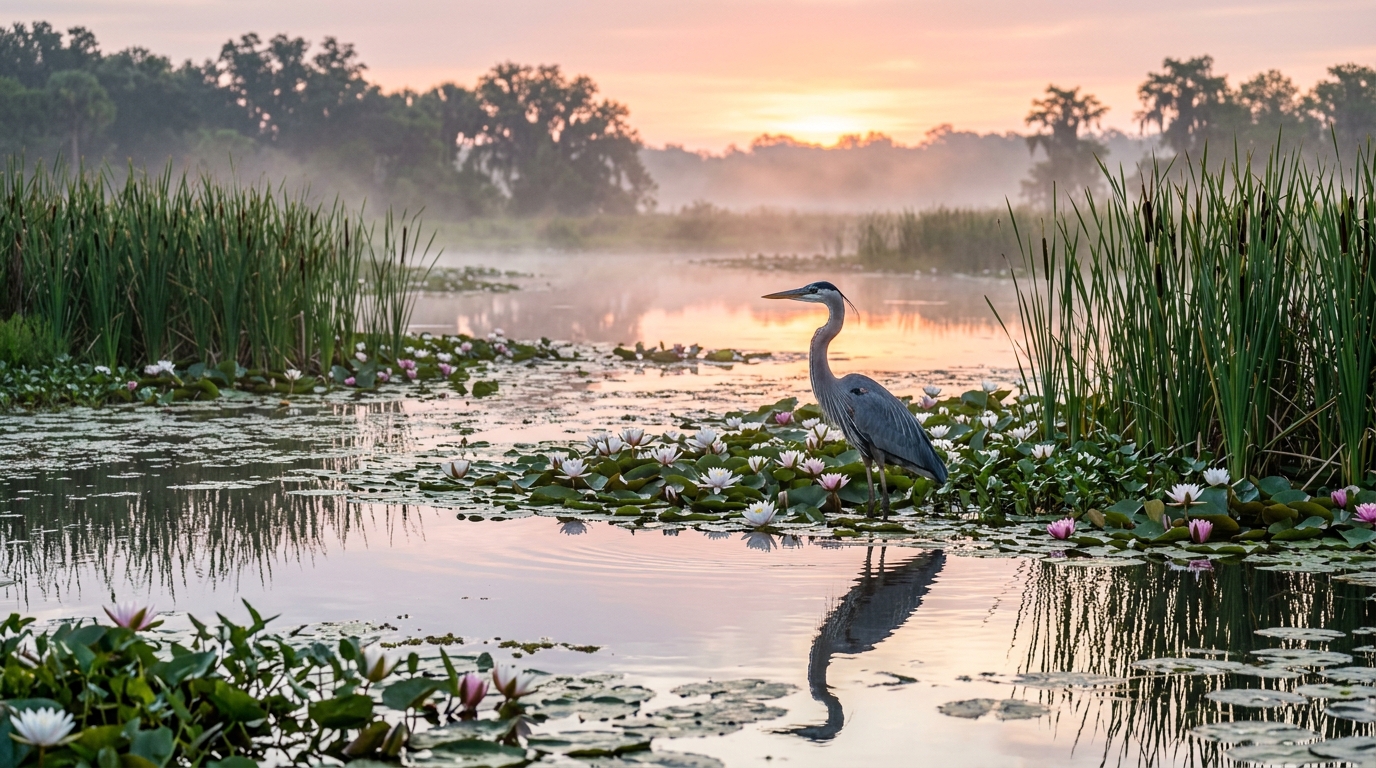
Often characterized as the ‘kidneys of the landscape’, wetlands are dynamic transitional ecotones where land meets water. Defined by persistent inundation, hydric soils, and hydrophytic vegetation, wetlands cover only 6% of Earth’s surface yet store massive quantities of organic carbon, purify global freshwater networks, buffer catastrophic floodwaters, and support 40% of all planetary species.
For centuries, human civilizations viewed wetlands as pestilential wastelands—muddy breeding grounds for disease, mosquitoes, and foul vapors that had to be drained, diked, and paved over for agriculture and urban development. More than 50% of the world’s historic wetlands were destroyed by human activity during the 20th century alone.
Today, modern ecological science recognizes wetlands as some of the most productive, economically valuable, and ecologically indispensable biomes on planet Earth. Functioning simultaneously as biological kidneys that cleanse toxic runoff and natural sponge buffers that absorb hurricane surges, wetlands are cornerstone ecosystems. In this comprehensive guide, we examine the three defining criteria of wetland status, classify the major wetland archetypes, analyze biogeochemical filtration mechanics, and explore wetland restoration ecology.
1. The Three Defining Scientific Hallmarks of a Wetland
In jurisdictional ecology and environmental jurisprudence, an area cannot be classified as a wetland merely because it is occasionally damp. A wetland must satisfy three rigorous, interdependent scientific criteria established by the Ramsar Convention and international environmental agencies:
- 1. Wetland Hydrology: The land must be submerged under shallow water or saturated in its root zone for a prolonged duration during the active growing season. This persistent inundation drives oxygen out of the soil pores, creating an extreme anaerobic (oxygen-depleted) environment.
- 2. Hydric Soils (Gleysols & Histosols): Under continuous water saturation, aerobic soil microbes consume all remaining oxygen. Anaerobic microbes then take over, using iron, manganese, and sulfate as alternative electron acceptors. This geochemical process reduces ferric iron (Fe3+) into ferrous iron (Fe2+), producing distinctive slate-gray or blue-gray mottling (gleying) and sulfuric odors. Where cold water prevents all decomposition, thick, dark organic peat soils (Histosols) accumulate.
- 3. Hydrophytic Vegetation: The plant community must be dominated by specialized species adapted to surviving in anoxic, waterlogged root zones. Ordinary terrestrial plants drown within days when deprived of soil oxygen; hydrophytes thrive through specialized morphological adaptations.
2. Classification: Marshes, Swamps, Bogs, and Fens
Wetlands are categorized based on their water source, botanical structure, and nutrient status:
A. Marshes: Grass-Dominated Sunlit Basins
Marshes are emergent wetlands dominated by non-woody, herbaceous vegetation such as cattails (Typha), bulrushes (Scirpus), reeds (Phragmites), and sedges. They receive water from surface runoff and groundwater streams, creating a nutrient-rich, neutral-to-alkaline pH environment. Tidal salt marshes buffer marine shores, while freshwater inland marshes support immense flocks of migratory waterfowl and serve as primary breeding habitats for amphibians.
B. Swamps: Woody-Canopy Wetland Forests
Unlike marshes, swamps are defined by the dominance of woody trees and mature shrubs. Famous examples include the cypress-tupelo swamps of the Florida Everglades, where bald cypress (Taxodium distichum) trees project woody vertical ‘cypress knees’ upward from their roots to improve mechanical anchorage in soft muck and aid root aeration. Tropical freshwater swamp forests and coastal mangrove swamps fall under this woody wetland category.
C. Bogs: Acidic, Rain-Fed Peatlands
Bogs are unique, nutrient-starved (ombrotrophic) peatlands fed exclusively by atmospheric precipitation, with zero groundwater inflow. They are dominated by dense carpets of peat moss (Sphagnum). Sphagnum moss secretes polyuronic acids that strip calcium and magnesium ions from the water, driving the pH down to hyper-acidic levels between 3.0 and 4.5. Because essential nitrogen is virtually absent, carnivorous plants—such as pitcher plants (Sarracenia) and sundews (Drosera)—evolved to trap and digest insects to obtain organic nitrogen.
D. Fens: Groundwater-Fed Mineral Peatlands
Fens are peat-accumulating wetlands fed by minerotrophic groundwater that has seeped through mineral-rich bedrock (such as limestone). As a result, fens are far less acidic than bogs (pH 6.0 to 8.0) and maintain rich supplies of dissolved calcium and bicarbonate, supporting exceptional floristic diversity, rare calciphile orchids, and diverse insect assemblages.
Diagnostic Matrix of Wetland Archetypes
3. Hydrophytic Plant Adaptations: Surviving in Suffocating Mud
To survive where soils are continuously devoid of oxygen, wetland plants evolved remarkable anatomical structures:
- Aerenchyma Tissue: The interior stems and petioles of plants like water lilies and cattails contain spongy, honeycomb-like tissues riddled with continuous longitudinal air channels (aerenchyma). This allows oxygen captured by green leaves in the open air to diffuse smoothly down into submerged roots buried in anoxic mud.
- Adventitious Roots and Hypertrophied Lenticels: When floodwaters submerge primary roots, plants like willows rapidly sprout adventitious roots directly from their submerged stems, while trunk lenticels swell into oversized, spongy pore clusters to maximize gas exchange.
- Anaerobic Fermentative Pathways: Hydrophytes possess metabolic enzymes that can switch to ethanol fermentation without accumulating toxic acetaldehyde concentrations, enabling cellular survival during prolonged flood immersion.
4. Nature’s Kidneys: The Biogeochemical Filtration Engine
Wetlands are extraordinary natural bio-refineries. As polluted agricultural runoff and urban wastewater slowly meander through wetland vegetation, three powerful purification processes occur simultaneously:
- Sediment Trapping: Dense stands of reeds and rushes create frictional drag, reducing water flow velocities by over 90%. Suspended silt, heavy metals, and particulate pollutants settle out of the water column into the mud beds within hours.
- Denitrification: Excess nitrogen fertilizer in runoff enters the wetland as nitrate (NO3-). In the anaerobic sediment horizons, denitrifying bacteria (such as Pseudomonas) use nitrate instead of oxygen for respiration, converting toxic waterborne nitrates into harmless nitrogen gas (N2) that bubbles safely into the atmosphere.
- Phosphorus Immobilization and Heavy Metal Chelation: Wetland plants rapidly absorb excess dissolved phosphorus into their biomass during the growing season. Simultaneously, humic substances in the peat chemically bind and immobilize heavy metals like lead, copper, and mercury, permanently locking them away in deep sediments.
5. Flood Attenuation, Peatland Carbon Storage, and Modern Conservation
Beyond water filtration, wetlands are nature’s supreme hydraulic shock absorbers. A single acre of intact marsh can store over 1.5 million gallons of floodwater, absorbing torrential rains like a colossal sponge and releasing the water gradually into river basins over weeks, preventing catastrophic urban flooding.
Furthermore, coastal wetlands and inland peat bogs sequester twice as much carbon as all of Earth’s forests combined, locking it into waterlogged, unoxidized peat beds. Draining wetlands exposes this ancient carbon to atmospheric oxygen, triggering rapid microbial oxidation that releases billions of tons of CO2 into the atmosphere.
Modern conservation imperatives center on the Ramsar Convention on Wetlands, strict ‘No Net Loss’ statutory wetland protection frameworks, dam removals, and large-scale wetland re-meandering to re-establish natural hydrological flow regimes.
6. Frequently Asked Questions (FAQs)
Q1: Why are wetlands referred to as ‘nature’s kidneys’?
Much like kidneys filter toxic waste and excess solutes from an animal’s bloodstream, wetlands filter sediment, synthetic fertilizers, heavy metals, and municipal effluents from surface waters through physical settling, plant absorption, and bacterial denitrification before the water reaches rivers, lakes, and drinking aquifers.
Q2: Why do carnivorous plants flourish in bogs?
Bogs are fed exclusively by rainwater and are dominated by acidic peat moss, creating soils virtually devoid of bioavailable nitrogen and phosphorus. Because ordinary plants cannot synthesize proteins without nitrogen, carnivorous plants evolved specialized traps (snap traps, pitfall pitchers, sticky flypapers) to catch insects and absorb their nitrogen-rich amino acids.
Q3: What are ‘cypress knees’ and what is their function?
Cypress knees are woody, conical structures that protrude vertically from the roots of bald cypress trees above the water level. While historically debated, ecological research shows they provide essential structural stability, anchoring giant trees securely in soft, shifting wetland muck, while aiding gas exchange during prolonged flooding.
Wetlands are among the most ecologically productive and functionally essential biomes on Earth. By filtering pollutants, buffering catastrophic floods, providing refuges for 40% of global wildlife, and storing vast planetary carbon reserves, protecting and restoring our remaining marshes, swamps, and peatlands is indispensable for ecological stability.
7. Mangrove Blue Carbon vs. Inland Wetland Peat Sequestration
When environmental scientists evaluate nature-based carbon solutions, wetlands consistently outperform terrestrial ecosystems. The secret of wetland carbon longevity lies in the biogeochemistry of waterlogged anoxia:
- Microbial Enzymatic Suppression: In dry terrestrial soils, oxygen allows fungi and bacteria to produce phenol oxidase enzymes that degrade organic matter. In waterlogged wetland soils, lack of dissolved oxygen depresses phenol oxidase activity by up to 95%. Phenolic compounds accumulate, acting as chemical preservatives that block all microbial decay.
- Soil Accretion vs. Sea Level Rise: Coastal salt marshes and mangrove wetlands actively build vertical soil elevation by trapping suspended riverine silt and generating belowground root biomass. If sea-level rise is gradual, healthy wetlands rise in tandem with ocean waters, continuously locking fresh layers of carbon into deep geological strata.
- Methane (CH4) Trade-Offs: Freshwater wetlands release methane due to the activity of anaerobic methanogenic archaea. However, coastal saline wetlands (salinity > 18 ppt) contain abundant dissolved sulfate (SO42-). Sulfate-reducing bacteria outcompete methanogens, allowing coastal wetlands to store immense carbon stocks with virtually zero methane emissions.
8. The Ramsar Convention and International Wetland Jurisprudence
Signed in the Iranian city of Ramsar in 1971, the Ramsar Convention on Wetlands was the world’s very first modern intergovernmental treaty focused on conserving a specific biome. Today, 172 contracting nations protect over 2,400 Ramsar Sites covering 250 million hectares worldwide (such as the Pantanal in South America, Kakadu in Australia, and the Sundarbans in India/Bangladesh).
Under Ramsar guidelines, member states must maintain the ‘ecological character’ of designated sites and formulate national wetland policies that enforce the ‘wise use’ principle—balancing human water usage with the ecological preservation of aquatic biodiversity and floodwater retention.
9. Global Comparative Case Studies and Field Methodologies
Scientific exploration of Wetland Ecology: Marshes, Swamps, Bogs, and Nature’s Ultimate Hydrological Filters requires examining long-term empirical field data across diverse continents. Over the past five decades, ecological research stations—such as the Smithsonian Tropical Research Institute, the Long Term Ecological Research (LTER) network, and the European FluxNet system—have gathered millions of quantitative data points that demonstrate how microclimates, species interactions, and human pressures reshape habitat integrity over time.
Standardized field methodologies involve combining permanent forest dynamic plots (typically 50-hectare research quadrats where every tree exceeding 1 cm in diameter is tagged, mapped, and monitored) with eddy covariance flux towers. These towers rise high above forest canopies, measuring the continuous net ecosystem exchange (NEE) of carbon dioxide, water vapor, and heat fluxes between vegetation and the atmosphere at 20-millisecond frequencies, providing absolute empirical confirmation of planetary climate buffering.
Quantitative Field Metrics and Monitoring Parameters
10. Multilateral Policy Frameworks and 2030 Sustainable Development Goals
Preserving the integrity of Wetland Ecology: Marshes, Swamps, Bogs, and Nature’s Ultimate Hydrological Filters is intrinsically linked to achieving the United Nations 2030 Sustainable Development Goals (SDGs), particularly SDG 13 (Climate Action), SDG 14 (Life Below Water), and SDG 15 (Life on Land). International conventions, including the Convention on Biological Diversity (CBD) and the United Nations Framework Convention on Climate Change (UNFCCC), now mandate that national ecological action plans formally account for ecosystem services within gross domestic accounting systems.
Furthermore, the emergence of the Taskforce on Nature-related Financial Disclosures (TNFD) is revolutionizing corporate environmental responsibility. Multinational financial institutions and corporations are now legally required to assess, disclose, and actively mitigate their physical supply chain dependencies on wild ecosystems. By aligning private capital allocation with ecological regeneration, humanity is establishing the financial foundations necessary to ensure long-term evolutionary equilibrium across all global biomes.
Addressing the challenges outlined in ‘Wetland Ecology: Marshes, Swamps, Bogs, and Nature’s Ultimate Hydrological Filters’ demands a unified three-tiered approach: (1) Immediate legal moratoriums on industrial land conversion in primary frontier wildernesses; (2) Sovereign debt restructuring through debt-for-nature swaps that empower local conservation trusts; and (3) Scaling high-integrity biodiversity credits that directly fund local Indigenous communities and frontline conservation stewards.