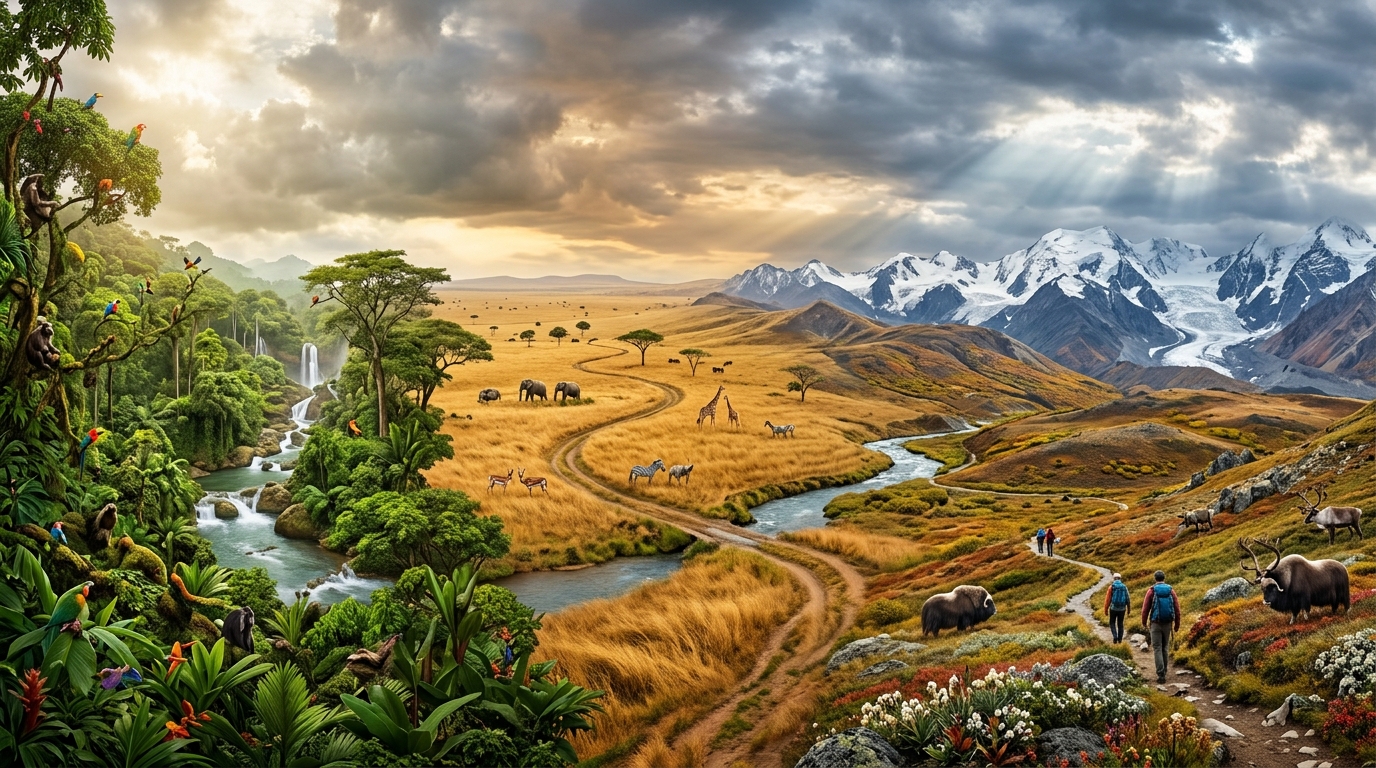
A terrestrial biome is a planetary-scale community of flora and fauna shaped primarily by two fundamental abiotic drivers: mean annual temperature and annual precipitation. From the frost-shattered soils of the Arctic tundra to the multi-tiered canopies of equatorial rainforests, biomes define how living systems harness solar energy, cycle minerals, and adapt to climatic boundaries.
The surface of planet Earth is an intricate mosaic of physical environments. When ecologists examine broad continental landscapes, they classify life into extensive regional complexes known as terrestrial biomes. Unlike specific local ecosystems—such as an individual vernal pool or a single hillside grove—a biome encompasses thousands of interconnected ecosystems bound by overarching climatic regimes, comparable vegetative structures, and parallel evolutionary adaptations.
In this authoritative guide, we examine the fundamental abiotic forces governing biome distribution, dissect the Whittaker climograph model, detail each of the major terrestrial biomes, explore pedological soil classifications, evaluate faunal survival mechanisms, and address the destabilizing impacts of anthropogenic climate change across continental biomes.
1. The Fundamental Abiotic Drivers: Temperature, Insolation, and Precipitation
The geographic distribution of terrestrial biomes is neither random nor haphazard. It is governed strictly by the interaction of astronomical solar angles, global atmospheric convection cells (Hadley, Ferrel, and Polar cells), and prevailing oceanic currents. Together, these physical phenomena establish distinct regional patterns of temperature and moisture:
- Solar Radiation Gradient: Because Earth is an oblate spheroid tilted 23.5 degrees on its axis, equatorial regions receive concentrated, direct solar radiation year-round. Conversely, high-latitude polar regions receive solar energy at shallow oblique angles, spreading photons over vast surface areas and enduring months of total solar absence.
- Atmospheric Convection and Precipitation Corridors: Intense equatorial heating forces warm, moist air to rise (the Intertropical Convergence Zone or ITCZ). As this air ascends, it expands and cools, precipitating torrential rains that sustain equatorial rainforests. The dry, desiccated air then descends around 30° North and South latitude, creating persistent high-pressure belts that generate the planet’s great subtropical deserts (such as the Sahara, Arabian, and Kalahari deserts).
- Continentality and Rain Shadow Effects: Large continental interiors (such as Central Asia or the North American Great Plains) experience extreme temperature swings and suppressed precipitation because maritime moisture cannot penetrate deeply inland. Furthermore, mountain ranges force moisture-laden winds upward (orographic lift), causing heavy windward precipitation while casting hyper-arid rain shadows on leeward slopes.
The Whittaker Biome Matrix: Precipitation vs. Temperature
In the mid-20th century, pioneering plant ecologist Robert Whittaker mapped the global distribution of biomes along two primary axes: mean annual temperature (-15°C to +30°C) and mean annual precipitation (0 to 450 cm). Whittaker’s model proved that whenever a given combination of temperature and precipitation occurs anywhere on the globe, natural selection produces vegetation with convergent morphological structures, regardless of whether the species share immediate evolutionary ancestry.
2. Detailed Anatomical Profiles of Earth’s Major Biomes
A. The Arctic and Alpine Tundra: Biomes at the Edge of Life
Occupying the high northern latitudes beyond the treeline, the Arctic tundra is an austere biome characterized by brutal winds, sub-zero conditions, and an active soil layer underlain by continuous permafrost. The growing season lasts a mere 50 to 60 days, during which the sun remains above the horizon 24 hours a day.
Because tree roots cannot penetrate the frozen permafrost barrier and branches cannot survive abrasive ice storms, vegetation is exclusively low-stature: prostrate willow shrubs (Salix arctica), cushion-forming saxifrages, reindeer moss (Cladonia rangiferina), and cottongrass. Arctic fauna exhibit extreme morphological insulation; muskoxen (Ovibos moschatus) possess dense under-wool (qiviut) eight times warmer than sheep’s wool, while Arctic foxes (Vulpes lagopus) utilize countercurrent heat exchangers in their paws to prevent systemic hypothermia.
B. Temperate Grasslands and Steppes: The Breadbaskets of Civilizations
Known variously as prairies in North America, pampas in South America, steppes in Eurasia, and veldts in South Africa, temperate grasslands occur where rainfall is sufficient to prevent desertification but insufficient to support dense closed forests. Periodic wildfires and intense grazing by massive ungulate herds (such as historic American bison and Eurasian saiga antelope) suppress woody tree seedling establishment.
The secret of the temperate grassland lies underground. Up to 80% of total plant biomass resides below the soil surface as dense, fibrous root systems that penetrate several meters deep. Over millennia, the annual die-back and decomposition of these extensive roots created Mollisols—the darkest, most chemically fertile soils on Earth. Tragically, because of their extreme agricultural fertility, over 95% of native tallgrass prairies have been plowed for cereal agriculture.
C. Mediterranean Sclerophyllous Shrublands (Chaparral)
Occurring in just five isolated regions on Earth—the Mediterranean Basin, coastal California, central Chile, the Cape Province of South Africa (fynbos), and southwestern Australia—this biome experiences hot, hyper-dry summers and mild, rainy winters. Plants are defined as sclerophyllous, meaning they produce small, tough, leathery leaves coated with waxy cuticles and volatile aromatic oils (such as rosemary, thyme, and sage) to prevent summer desiccation.
These volatile oils make the chaparral naturally pyrophytic. Periodic brushfires sweep through every 10 to 30 years. Rather than being devastated, many native shrubs—such as chamise (Adenostoma fasciculatum)—sprout vigorously from underground woody lignotubers (burls) within weeks of fire passage, while seed germination is chemically triggered by smoke compounds (karrikins).
D. Tropical Savannas: Fire-Prone Landscapes of Giant Herbivores
Covering nearly half of the African continent as well as extensive expanses of Australia, South America (the Cerrado), and India, tropical savannas are open grasslands punctuated by scattered drought-resistant trees like acacias (Vachellia) and colossal baobabs (Adansonia). Savannas are defined by a severe alternating hydrologic regime: a dramatic, torrential wet season followed by months of absolute drought.
Savannas support the planet’s greatest biomass of large mammalian herbivores. To avoid fatal competition, species have evolved precise niche partitioning. Giraffes forage on canopy acacia crowns above 5 meters; elephants browse woody branches and knock over trees; zebras consume coarse, fibrous grass tops; and wildebeest graze the tender green shoots left behind. This sequential grazing keeps the savanna productive and balances the woody-to-grass vegetative ratio.
3. Convergent Evolution: Parallel Solutions across Continents
One of the most profound evolutionary revelations uncovered by biome analysis is the phenomenon of convergent evolution. When geographically isolated organisms face identical climatic constraints in different parts of the world, natural selection independently molds them into nearly identical body plans and physiological mechanisms.
A quintessential example is observed in desert flora: American cacti (family Cactaceae) and African euphorbias (family Euphorbiaceae) are separated by over 100 million years of independent evolutionary divergence. Yet, both have independently lost their leaves to minimize transpirational surface area, developed swollen green succulent stems to store water and conduct CAM photosynthesis, and evolved sharp defensive spines to deter thirsty herbivores. When viewed side-by-side, species like Carnegiea gigantea (Saguaro) and Euphorbia ingens appear nearly indistinguishable despite possessing radically different genetic lineages.
4. Pedogenesis and Biogeochemical Cycling across Biomes
Soil is not merely inactive rock dust; it is a dynamic living matrix co-created by vegetation, climate, topography, and microorganisms over geological timescales. Each terrestrial biome generates a unique soil order characterized by distinct chemical horizons:
- Podzolization in the Boreal Forest: High rainfall combined with acidic conifer needle litter produces intensely leached, ash-colored E-horizons (Spodosols). Organic acids strip iron and aluminum from upper soil strata, leaving behind pale quartz sands incapable of sustaining commercial broadleaf crops.
- Calcification in Grasslands and Arid Shrublands: In biomes where evaporation exceeds precipitation, water moves upward through soil capillaries. Soluble calcium carbonate precipitates in the subsurface, cementing soil particles into hardened, impermeable petrocalcic horizons known colloquially as ‘caliche’.
- Laterization in Equatorial Rain Belts: Millennia of intense warm rainfall leach away all soluble alkaline minerals, leaving behind deep, highly weathered brick-red horizons (Oxisols) composed almost exclusively of insoluble hydrated oxides of iron and aluminum.
5. Biome Shifts under Anthropogenic Climate Forcing
For the past 10,000 years (the Holocene epoch), Earth’s terrestrial biomes maintained relatively stable geographic boundaries. However, rapid anthropogenic emissions of greenhouse gases are altering the thermal and moisture baselines that anchor these biomes. Ecologists are now documenting profound planetary shifts:
- Poleward and Altitudinal Migration: Temperate species are advancing poleward at an average rate of 17 kilometers per decade, while montane species are migrating uphill at 11 meters per decade. For mountaintop alpine species, however, there is no higher elevation left to escape to—an extinction trap known as the ‘escalator to extinction’.
- Shrubification of the Tundra: Rising Arctic temperatures are encouraging woody alder, birch, and willow shrubs to invade the historically mossy tundra. These darker shrubs reduce the surface albedo (reflectivity) of the snow, absorbing more solar heat and accelerating permafrost melt in a dangerous self-reinforcing feedback loop.
- Savannization of the Amazon Basin: Combined pressures from deforestation and prolonged drought are pushing the eastern and southern Amazon rainforest past its biological tipping point, transforming dense multi-layered humid forests into fire-prone degraded scrub savannas.
6. Frequently Asked Questions (FAQs)
Q1: What is an ‘ecotone’ between biomes?
An ecotone is a dynamic transition zone where two adjacent biomes blend and overlap—such as the forest-tundra boundary or the savanna-forest mosaic. Ecotones often exhibit heightened biodiversity (the ‘edge effect’) because they contain species representative of both neighboring biomes as well as unique edge-adapted generalists.
Q2: Why do temperate grasslands have richer soils than tropical rainforests?
Temperate grasslands produce massive underground root networks that decompose slowly each year in moderate climates, allowing deep, dark organic humus (Mollisols) to accumulate. In contrast, tropical rainforests experience year-round heat and torrential rains that rapidly wash away minerals and decompose surface organic matter instantly, leaving soils chemically leached and impoverished.
Q3: How do CAM plants survive in hyper-arid desert biomes?
Crassulacean Acid Metabolism (CAM) is an evolutionary photosynthetic adaptation. Unlike normal plants that open their stomata during the hot day to absorb carbon dioxide, CAM plants keep their stomata sealed tightly by day to prevent water loss. They open stomata only at night when air is cool and humid, storing CO2 as malic acid in cellular vacuoles, which is then used for photosynthesis when daylight returns.
Q4: Can a biome be restored once it has experienced desertification?
Ecological restoration is possible but requires substantial time, capital, and biological intervention. Techniques such as establishing native nitrogen-fixing shelterbelts (e.g., Africa’s Great Green Wall), rainwater harvesting contour swales, rotational grazing to stimulate dormant seedbeds, and biological soil crust inoculation can reverse desertification and stabilize soils.
Terrestrial biomes are Earth’s continental expressions of life adapting to temperature and moisture. Understanding biome dynamics, soil pedogenesis, and convergent evolutionary strategies provides the vital ecological foundation needed to forecast biome shifts, protect threatened habitats, and preserve planetary biodiversity in a changing world.
9. Global Comparative Case Studies and Field Methodologies
Scientific exploration of Terrestrial Biomes of the World: A Comprehensive Study of Earth’s Major Ecological Realms requires examining long-term empirical field data across diverse continents. Over the past five decades, ecological research stations—such as the Smithsonian Tropical Research Institute, the Long Term Ecological Research (LTER) network, and the European FluxNet system—have gathered millions of quantitative data points that demonstrate how microclimates, species interactions, and human pressures reshape habitat integrity over time.
Standardized field methodologies involve combining permanent forest dynamic plots (typically 50-hectare research quadrats where every tree exceeding 1 cm in diameter is tagged, mapped, and monitored) with eddy covariance flux towers. These towers rise high above forest canopies, measuring the continuous net ecosystem exchange (NEE) of carbon dioxide, water vapor, and heat fluxes between vegetation and the atmosphere at 20-millisecond frequencies, providing absolute empirical confirmation of planetary climate buffering.
Quantitative Field Metrics and Monitoring Parameters
10. Multilateral Policy Frameworks and 2030 Sustainable Development Goals
Preserving the integrity of Terrestrial Biomes of the World: A Comprehensive Study of Earth’s Major Ecological Realms is intrinsically linked to achieving the United Nations 2030 Sustainable Development Goals (SDGs), particularly SDG 13 (Climate Action), SDG 14 (Life Below Water), and SDG 15 (Life on Land). International conventions, including the Convention on Biological Diversity (CBD) and the United Nations Framework Convention on Climate Change (UNFCCC), now mandate that national ecological action plans formally account for ecosystem services within gross domestic accounting systems.
Furthermore, the emergence of the Taskforce on Nature-related Financial Disclosures (TNFD) is revolutionizing corporate environmental responsibility. Multinational financial institutions and corporations are now legally required to assess, disclose, and actively mitigate their physical supply chain dependencies on wild ecosystems. By aligning private capital allocation with ecological regeneration, humanity is establishing the financial foundations necessary to ensure long-term evolutionary equilibrium across all global biomes.
Addressing the challenges outlined in ‘Terrestrial Biomes of the World: A Comprehensive Study of Earth’s Major Ecological Realms’ demands a unified three-tiered approach: (1) Immediate legal moratoriums on industrial land conversion in primary frontier wildernesses; (2) Sovereign debt restructuring through debt-for-nature swaps that empower local conservation trusts; and (3) Scaling high-integrity biodiversity credits that directly fund local Indigenous communities and frontline conservation stewards.