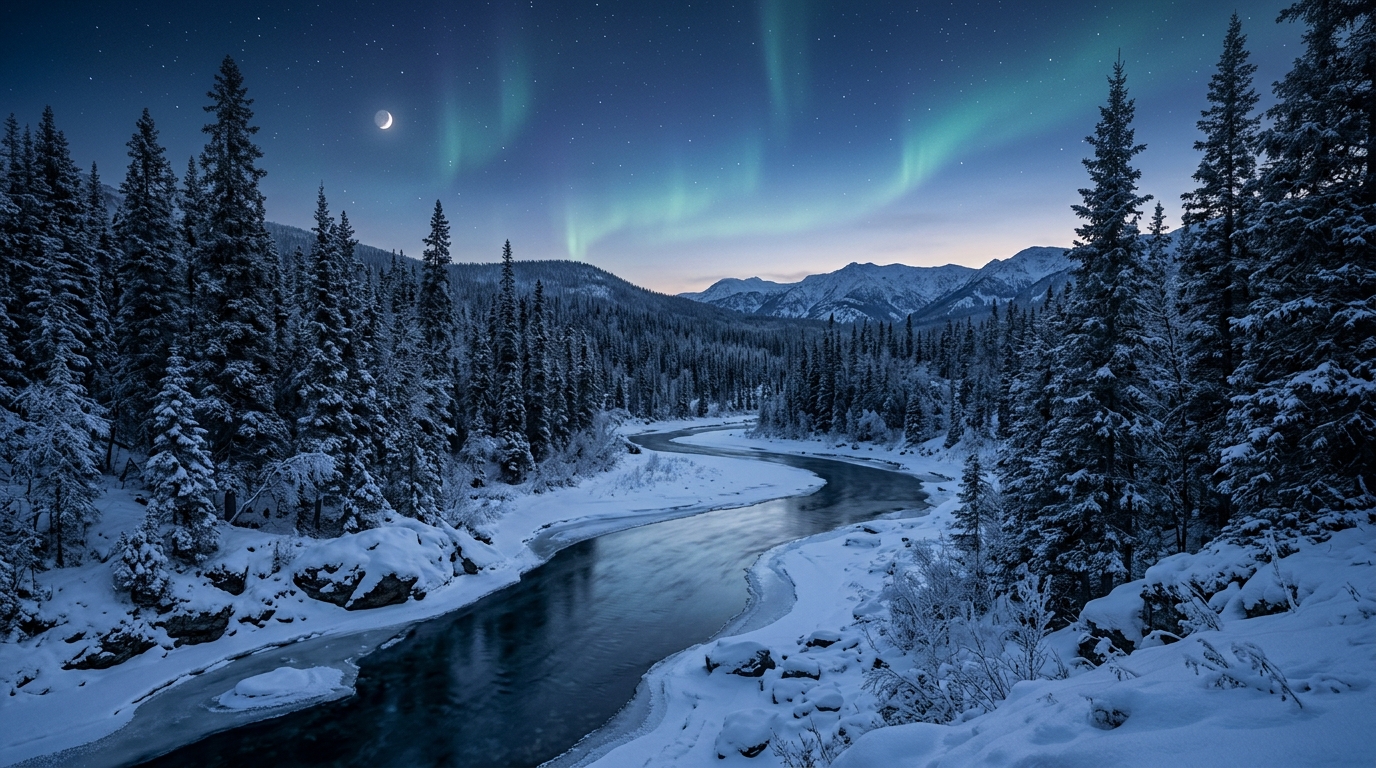
Encircling the high northern latitudes like a continuous emerald crown, the boreal forest—or taiga—is Earth’s largest terrestrial biome. Covering approximately 11% of the planet’s continental land area across Russia, Canada, Scandinavia, and Alaska, the taiga stores more organic carbon in its peatlands and permafrost than all tropical and temperate forests combined.
Stretching uninterrupted across thousands of miles below the Arctic tundra, the boreal forest represents one of nature’s greatest triumphs over extreme cold. Characterized by long, harsh winters, short cool summers, and extensive permafrost, the taiga is dominated by cold-tolerant coniferous evergreens including spruce (Picea), fir (Abies), pine (Pinus), and deciduous larches (Larix).
Far from being an empty, barren expanse, the boreal biome is a dynamic ecological juggernaut. It regulates hemispheric climate cycles, filters massive quantities of freshwater, produces trillions of migratory songbirds each summer, and acts as the planet’s paramount land-based carbon sink. In this extensive guide, we analyze the biological adaptations of boreal flora, investigate the mechanics of peatland soil storage, review wildfire succession, and examine the looming threats of climate destabilization.
1. Geographic Extent and Severe Climatic Realities
The boreal forest forms a circumpolar ring across the Northern Hemisphere between roughly 50° and 70° North latitude. Over 70% of the biome lies across the vast expanse of Russian Siberia, while the remaining 30% spans Canada, the state of Alaska (USA), Sweden, Finland, and Norway. There is no comparable boreal belt in the Southern Hemisphere because landmasses terminate at southern mid-latitudes before reaching suitable sub-polar zones.
Climatically classified as subarctic (Köppen Dfc, Dfd, Dwc), the taiga experiences some of the most extreme annual temperature ranges on Earth:
- Fierce Winters: Sub-freezing temperatures persist for 6 to 8 months. In central and eastern Siberia, winter temperatures regularly plunge below -50°C (-58°F).
- Compressed Growing Seasons: The frost-free season typically lasts a mere 50 to 100 days, during which plants must grow, reproduce, and prepare for the return of brutal frosts.
- Low Precipitation with Low Evaporation: Annual precipitation is relatively modest (300 to 800 mm), but because low temperatures drastically suppress evaporation, the landscape remains chronically moist, giving rise to millions of bogs, fens, and lakes.
2. Evolutionary Adaptations of Coniferous Trees
Conifers have evolved an elegant suite of morphological and physiological traits that allow them to flourish where broadleaved deciduous trees perish from cold stress:
Conical Architecture and Downward-Sloping Branches
The narrow, conical shape of spruces and firs is an architectural defense against heavy snow accumulation. Thick winter snowfalls slide harmlessly off downward-sloping, flexible branches, preventing catastrophic limb breakage that would expose tree heartwood to fungal rot.
Needle Morphology and Immediate Photosynthesis
Conifer needles feature a reduced surface-to-volume ratio, heavily sunken stomata, and a thick waxy coating (cutin) that drastically reduces moisture loss in dry, freezing winter air. Furthermore, because conifers remain evergreen, they do not waste precious energy growing an entire canopy of new foliage in spring. The instant ambient temperatures rise above freezing in late spring, needles begin photosynthesizing immediately, maximizing the short growing season.
Cellular Cryoprotection and Supercooling
Boreal conifers withstand sub-zero temperatures through physiological hardening. As autumn approaches, tree cells actively move water from inside the cytoplasm into intercellular spaces between cells. When ice forms, it freezes in the spaces between cells without rupturing vital internal organelles. Simultaneously, the cytoplasm accumulates concentrated sugars, organic acids, and antifreeze proteins that depress the internal freezing point (supercooling).
3. The Peatland Carbon Vault and Permafrost Dynamics
While the standing timber of the boreal forest is impressive, the true ecological powerhouse of the biome lies beneath the mossy forest floor. Boreal soils and peatlands (muskegs, bogs, and fens) represent the single densest terrestrial carbon vault on the planet.
In cold, waterlogged peatland soils, microbial decomposition slows to a near standstill due to anoxia (lack of oxygen) and acidic conditions created by Sphagnum mosses. Instead of rotting and releasing carbon dioxide, dead plant matter accumulates year after year, century after century, forming thick deposits of carbon-dense peat.
Table: Carbon Storage Comparison Across Major Forest Biomes
4. Wildfire as an Ecological Driver of Forest Rebirth
Wildfire is not an unnatural disaster in the boreal forest; it is the fundamental rejuvenating heartbeat of the ecosystem. Conifer resin, dry needle litter, and dense stands create naturally flammable conditions. Historically, lightning-ignited wildfires sweep across millions of hectares on cyclical intervals of 50 to 150 years.
Many boreal species are serotinous—meaning their reproductive cycles are directly triggered by fire. For example, jack pine (Pinus banksiana) and black spruce (Picea mariana) produce cones sealed shut with tough resin. The intense heat of a passing wildfire melts the resin, releasing millions of seeds onto newly cleared, nutrient-enriched ash beds, free from canopy competition.
5. Climate Change, Permafrost Thawing, and Boreal Tipping Points
The Arctic and sub-Arctic regions are warming between two and four times faster than the global average—a phenomenon termed Arctic amplification. This rapid warming threatens to transform the boreal forest from a vital carbon sink into an accelerating carbon emitter:
- Permafrost Degradation: As permanently frozen soils thaw, ancient organic matter is exposed to microbial decomposition. In dry conditions, this releases carbon dioxide; in waterlogged conditions, anaerobic microbes generate methane (CH4), a greenhouse gas over 28 times more potent than CO2 over a century.
- Insect Outbreaks: Warmer winters fail to kill overwintering bark beetle larvae. Infestations of spruce bark beetles (Dendroctonus rufipennis) have killed millions of hectares of healthy conifer stands across Alaska and western Canada.
- Megafires: Lengthening fire seasons and hotter temperatures generate unprecedented megafires that burn deep into peat strata, releasing thousands of years of stored carbon in weeks.
6. Frequently Asked Questions (FAQs)
Q1: What is the difference between Taiga and Boreal Forest?
The terms are often used interchangeably. Historically, ‘taiga’ is a Russian word specifically describing the sparse, northernmost transition zone where stunted conifers border the open Arctic tundra. ‘Boreal forest’ refers more broadly to the entire southern, dense closed-canopy conifer forest belt across North America and Eurasia.
Q2: Why do larch trees drop their needles if they are conifers?
Larches (Larix) are deciduous conifers. In the extreme continental climates of eastern Siberia, winter temperatures plunge below -65°C. In such hyper-frigid environments, maintaining needles throughout winter causes extreme dehydration that even conifers cannot tolerate. Dropping their soft needles allows larches to survive the coldest inhabited forests on Earth.
Q3: How does thawing permafrost create ‘drunken trees’?
Conifers in permafrost areas rely on an active summer thaw layer for root stability. When deep permafrost melts, the ground collapses unevenly, forming thermokarst sinkholes and muddy slumps. Trees lose vertical mechanical support, tilting randomly at odd angles—a condition commonly referred to as ‘drunken forests’.
The boreal forest is our planet’s greatest terrestrial carbon storehouse and a masterwork of cold adaptation. Coniferous evergreens, peatlands, and natural fire cycles maintain ecological balance across the northern hemisphere. Preserving boreal peatlands and mitigating global warming are vital to keep these ancient carbon reserves safely locked in the soil.
7. The Great Mammalian Migrations and Predator-Prey Cycles of the Taiga
The boreal biome is characterized by rhythmic, synchronized population oscillations between apex predators and their specialized prey. The most famous ecological study in vertebrate zoology is the 10-year cycle of the Canada Lynx (Lynx canadensis) and the Snowshoe Hare (Lepus americanus):
- Morphological Specialization: Both species possess hyper-expanded, heavily furred paws that function as biological snowshoes, allowing them to traverse deep, powdery subarctic snowpacks without sinking. The hare’s coat undergoes seasonal hormonal molting, transforming from mottled summer brown to pure snow-white in winter.
- Cyclical Dynamics: Snowshoe hares can reproduce rapidly, producing multiple litters each summer. As hare populations surge, lynx populations expand in response due to high cub survival. Eventually, overbrowsing and high predation crash the hare population. Deprived of prey, lynx reproductive rates collapse, allowing vegetation to recover and initiating a new 10-year cycle.
8. Paleolithic Boreal Peat Mummies and Archaeobotany
The hyper-acidic, cold, anoxic waters of boreal Sphagnum bogs possess extraordinary preservative qualities. Sphagnan—a complex polysaccharide released by peat mosses—binds calcium and tans organic keratin and collagen tissues. Over the past three centuries, peat cutters across northern Europe and Siberia have unearthed hundreds of remarkably preserved ‘bog bodies’ dating from the Iron Age (such as the famous Tollund Man in Denmark).
These ancient remains retain intact skin, facial expressions, internal organs, and stomach contents after more than 2,400 years, providing archaeologists with pristine physical evidence of ancient human diets, clothing made of boreal furs, and ritual practices in the subarctic peatlands.
9. Global Comparative Case Studies and Field Methodologies
Scientific exploration of Boreal Forests (Taiga): Earth’s Largest Terrestrial Biome and Global Carbon Reservoir requires examining long-term empirical field data across diverse continents. Over the past five decades, ecological research stations—such as the Smithsonian Tropical Research Institute, the Long Term Ecological Research (LTER) network, and the European FluxNet system—have gathered millions of quantitative data points that demonstrate how microclimates, species interactions, and human pressures reshape habitat integrity over time.
Standardized field methodologies involve combining permanent forest dynamic plots (typically 50-hectare research quadrats where every tree exceeding 1 cm in diameter is tagged, mapped, and monitored) with eddy covariance flux towers. These towers rise high above forest canopies, measuring the continuous net ecosystem exchange (NEE) of carbon dioxide, water vapor, and heat fluxes between vegetation and the atmosphere at 20-millisecond frequencies, providing absolute empirical confirmation of planetary climate buffering.
Quantitative Field Metrics and Monitoring Parameters
10. Multilateral Policy Frameworks and 2030 Sustainable Development Goals
Preserving the integrity of Boreal Forests (Taiga): Earth’s Largest Terrestrial Biome and Global Carbon Reservoir is intrinsically linked to achieving the United Nations 2030 Sustainable Development Goals (SDGs), particularly SDG 13 (Climate Action), SDG 14 (Life Below Water), and SDG 15 (Life on Land). International conventions, including the Convention on Biological Diversity (CBD) and the United Nations Framework Convention on Climate Change (UNFCCC), now mandate that national ecological action plans formally account for ecosystem services within gross domestic accounting systems.
Furthermore, the emergence of the Taskforce on Nature-related Financial Disclosures (TNFD) is revolutionizing corporate environmental responsibility. Multinational financial institutions and corporations are now legally required to assess, disclose, and actively mitigate their physical supply chain dependencies on wild ecosystems. By aligning private capital allocation with ecological regeneration, humanity is establishing the financial foundations necessary to ensure long-term evolutionary equilibrium across all global biomes.
Addressing the challenges outlined in ‘Boreal Forests (Taiga): Earth’s Largest Terrestrial Biome and Global Carbon Reservoir’ demands a unified three-tiered approach: (1) Immediate legal moratoriums on industrial land conversion in primary frontier wildernesses; (2) Sovereign debt restructuring through debt-for-nature swaps that empower local conservation trusts; and (3) Scaling high-integrity biodiversity credits that directly fund local Indigenous communities and frontline conservation stewards.
In addition to technological monitoring and multilateral treaties, grassroots environmental education serves as the vital cultural catalyst for enduring change. When local communities and academic institutions establish participatory citizen-science observatories, community members actively participate in biodiversity monitoring, water chemistry sampling, and phenological tracking. This democratic approach to scientific discovery transforms local populations from passive observers into passionate, empowered guardians of their ancestral natural heritage.
As we navigate the ecological challenges of the Anthropocene, the choice before humanity is clear: we can continue the trajectory of short-sighted industrial exploitation that destabilizes our planet’s life-support machinery, or we can embrace a profound ecological renaissance rooted in scientific rigor, Indigenous wisdom, and restorative environmental ethics. By protecting intact habitats, restoring degraded landscapes, and honoring the intricate ecological networks that bind all living creatures, we secure a flourishing, biodiverse Earth for generations to come.